Reviewed by: Shoaib Abid
CEO, Revenue Cycle Management & Provider Credentialing Specialist
Last Reviewed: July 2026
Credentialing platforms earn their cost through integrations: provider data should enter one system once, flow to primary sources for verification, and land in your CRM, EHR, and billing system without anyone retyping it. In 2026 that means Salesforce native credentialing apps, REST APIs for verification, and AI models trained on structured provider data. This guide covers how each integration path works, what data the AI layer actually needs, and an honest evaluation of two platforms practice managers keep asking us about: Verifiable and Zivian Health.Same disclosure as our software roundup: Medicotech sells none of these products. We run a credentialing and billing service, which makes us a neutral referee here.
Why do credentialing integrations matter?
Because every rekeyed field is a future denial. Provider data that gets typed into CAQH, retyped into a payer application, retyped into the EHR, and retyped into the billing system will eventually disagree with itself, and payers treat disagreement as grounds to reject applications and deny claims.
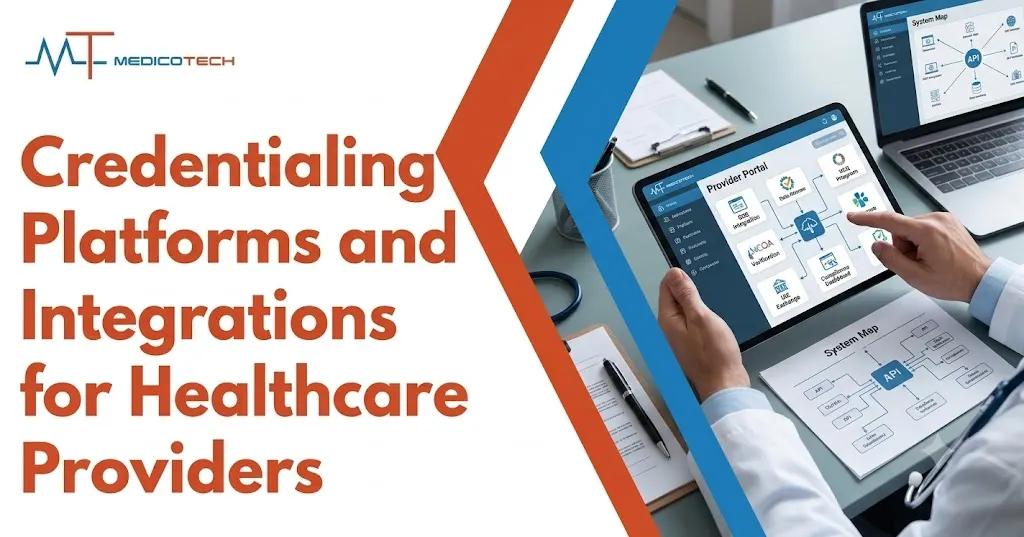
A well integrated credentialing stack has two directions of flow. Inbound: CAQH and NPPES profile data, state licensing boards, DEA, NPDB, and exclusion databases feed verification automatically. Outbound: verified provider records and effective dates flow to the systems that consume them, the CRM where contracting lives, the EHR where scheduling lives, the HRIS where employment lives, and the billing platform where every one of these fields turns into money or a denial. Judge any platform by how many of those hops still require a human with a keyboard.
Which credentialing platform integrates with Salesforce for healthcare providers?
Verifiable is the clearest answer in 2026: a pre built native Salesforce application, listed on the AppExchange, that the company describes as the only NCQA certified CVO running natively on Salesforce, with all 11 verification elements certified. Because it lives inside Salesforce rather than syncing to it, credentialing status connects directly to contracting in Health Cloud and onboarding in Service Cloud, and verifications run from the provider record itself.
The company reports processing over six million verifications per month, with direct API connections to more than 200 state and national license sources plus NPDB, OIG, and SAM, and customers publicly cite turnaround reductions of 67 percent. Treat those as vendor published and customer quoted figures to verify in references, but the architectural point stands on its own: for organizations already running provider operations on Salesforce, a native app removes an entire integration layer that connector based platforms have to maintain.
If you’re not a Salesforce shop, the calculus flips. Buying Salesforce to get credentialing is buying a platform to get a feature. The enterprise credentialing systems we covered in our roundup of the best credentialing software for healthcare integrate through Epic, HRIS, and FHIR paths instead, and fit organizations whose system of record is the EHR rather than the CRM.
What is a credential verification service with an API?
A credential verification service with an API lets your own systems request primary source verifications programmatically: send a provider’s identifiers, get back verified license status, exclusion checks, and NPI validation as structured data, with an audit trail. It’s the build option for organizations with engineering teams, versus the buy option of a full workflow platform.
The detail that separates vendors is how the verification happens. Direct to source connections query the issuing authority’s own systems (state boards, NPDB, OIG, SAM) and return structured, current data. Screen scraping bots read websites instead, and break silently when a board redesigns its page, which is how a verified license turns out to be a cached error. Ask any API vendor what percentage of their verifications run direct to source and what happens when a source is down.
When does the API route beat a platform? Three conditions, all required: you have engineers who’ll own the integration, you’re embedding verification inside a product or onboarding flow you already built, and your volume justifies per verification pricing. Miss any one and a platform, or a service that owns the whole problem, costs less in practice.
Want integration and vendor breakdowns like this monthly?
Join the Medicotech newsletter for practice managers.
What data do AI models need for healthcare provider credentialing?
AI credentialing models need the same records a human verifier reads, delivered as clean, consistently formatted, source linked data: identity, licensure, education, work history, malpractice history, and exclusion status. The models automate matching and monitoring; the data list doesn’t change.
The working data set:
- Identity anchors: NPI (validated against NPPES), full legal name, date of birth, and every name variant the provider has practiced under
- Licensure: license numbers per state, status, issue and expiration dates, pulled from state board sources
- DEA registration and controlled substance authority
- Education and training: school, residency, fellowship, with verification sources
- Board certification status from the certifying board
- Work history in consistent month and year format, with gaps explained
- Malpractice claims history, cross checked against the National Practitioner Data Bank
- Exclusion and sanction status against the HHS OIG list and SAM.gov, checked continuously rather than once.
Two requirements matter more than the list. First, data quality: AI models match records across sources, so the mismatches that slow human credentialing (Bob versus Robert, a transposed license digit) don’t disappear, they become automated false flags. Every serious vendor pairs the models with human review for exactly this reason. Second, auditability: an AI verified credential is only worth what its audit trail proves, so the record must show which source was checked, when, and what it returned. A model that can’t show its work fails the first NCQA or payer audit it meets.
How does Zivian Health handle credentialing automation?
Zivian Health approaches credentialing from the workforce compliance side rather than the payer enrollment side. The platform centers on nurse practitioner and physician assistant collaboration compliance: generating and maintaining state compliant collaboration agreements, tracking chart review ratios, and maintaining a 50 state knowledge base of NP and PA practice rules, backed by a marketplace of collaborating physicians for hard to staff oversight roles.
On credentialing specifically, Zivian’s automation covers license, certification, and credential tracking across the workforce, surfacing expirations and gaps, with automated licensing and renewal workflows and an exportable audit trail. Published case studies describe telehealth organizations using it to expand advanced practice teams into new states, with one virtual care company reporting an estimated six months of administrative burden saved across an 11 state expansion.
The honest evaluation: if your organization runs on NPs and PAs across multiple states, especially in telehealth, Zivian automates a compliance layer most credentialing platforms ignore entirely, and the collaboration agreement problem it solves is real and painful. What it is not is a payer enrollment engine. Getting those same providers credentialed, contracted, and loaded with Medicare, Medicaid, and commercial payers remains separate work, done by your team, a platform from our software roundup, or a service. Shortlist Zivian for the compliance layer; don’t expect it to replace the enrollment one.
Integrations are one answer. One team is the other.
Everything above solves the same underlying problem: provider data crossing system boundaries without breaking. APIs, native apps, and AI models are engineering answers to it. There’s also an organizational answer: put credentialing and billing on the same team, so the enrollment date never crosses a boundary at all.
That’s the model our credentialing team runs. Verification, payer enrollment, and contracting happen in the same operation as claim submission, inside our medical billing services, so effective dates, taxonomy codes, and fee schedules flow into the revenue cycle by walking across a team, not through an API. For a 500 provider network, buy the integrations. For a practice, the one team model gets you the same zero rekeying outcome without a single license fee, billed as a percentage of collections with no setup fees.
Not sure whether your problem needs an integration or an owner?
Get your free billing audit. A dedicated billing specialist reviews your last 90 days of claims and traces every credentialing related denial back to the system boundary it crossed.
Frequently Asked Questions
Does Salesforce have built in provider credentialing?
Salesforce Health Cloud includes provider network management capabilities, but full NCQA compliant credentialing on Salesforce comes through native applications from the AppExchange. Verifiable is the notable example, describing itself as the only NCQA certified CVO running natively on Salesforce, connecting credentialing status to Health Cloud contracting and Service Cloud onboarding.
Is a verification API cheaper than a credentialing platform?
Usually, if you have engineers. An API prices per verification or by volume and slots into onboarding flows you already built, while a platform charges subscription fees for the full workflow layer. The API route trades license cost for build and maintenance work, which only pays off for organizations with a product team.
What is direct to source verification?
Direct to source verification pulls credential data straight from the issuing authority (state boards, NPDB, OIG) through APIs rather than screen scraping websites. It matters because scraping bots break when a site changes layout, while source connections return structured, current data with an audit trail payers and accreditors accept.
Does Zivian Health replace a credentialing service?
Not for payer enrollment. Zivian centers on NP and PA workforce compliance: collaboration agreements, state by state regulatory rules, and license and credential tracking. It automates the compliance side of credentialing well for advanced practice heavy organizations, but getting providers enrolled and contracted with payers remains work for your team or a credentialing service.
What data quality problems break AI credentialing?
The same ones that break human credentialing, amplified: name mismatches across documents, unexplained work history gaps, stale CAQH profiles, and license numbers formatted differently between sources. AI models match records across databases, so a provider listed as Bob at one source and Robert at another produces false flags that still need human review.