
Reviewed by: Shoaib Abid
CEO, Revenue Cycle Management & Provider Credentialing Specialist
Last Reviewed: July 2026
Physician credentialing is the verification process payers and healthcare facilities use to confirm a doctor’s license, education, training, and work history before that doctor can treat patients under a facility’s name or bill insurance for care.
It’s the gate every physician walks through before the first claim gets paid. Skip it or rush it, and claims get denied on a provider who may be perfectly qualified to practice medicine.
If you’re bringing on a new physician this quarter, or you’re just trying to understand why your last hire couldn’t see patients for ten weeks, this guide walks through what credentialing actually verifies, how the process works in 2026, and what’s changed since NCQA tightened its standards last year.
What Is Physician Credentialing?
Physician credentialing is a formal review that verifies a provider is who they claim to be and is qualified to deliver the type of care they’re being hired, privileged, or paid to deliver. A credentialing team, whether that’s a hospital medical staff office, a payer’s network department, or an outsourced credentialing vendor, checks every claim on a provider’s application against the original source.
That means calling the medical school instead of trusting the diploma. Checking the state licensing board directly instead of accepting a scanned license. Confirming malpractice history through the carrier, not the provider’s summary. This step is called primary source verification, and it’s the backbone of the whole process.
Most commercial insurers, Medicare, Medicaid, and hospitals all pull this data from one shared source: CAQH ProView. Over 2.5 million providers maintain a profile there, and more than 1,000 health plans and hospitals draw from it instead of running separate applications from scratch. If your CAQH profile is incomplete or stale, every payer application behind it stalls too.
What Is the Physician Credentialing Process?
Credentialing follows a fairly consistent sequence, whether it’s a solo physician joining a new payer panel or a hospital system onboarding twelve new hires at once.
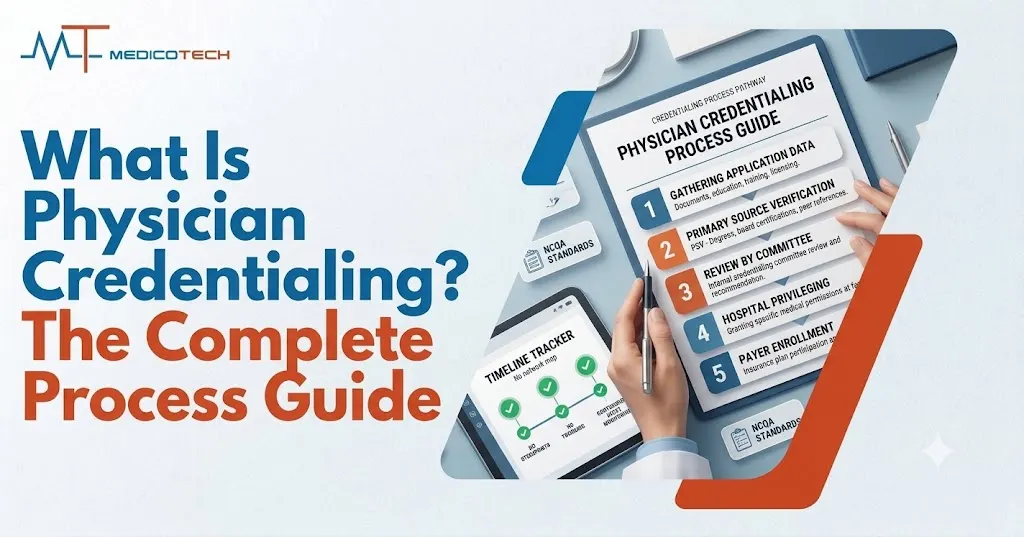
Step 1: Document collection
Government ID, an unbroken CV covering the last five to ten years with no unexplained gap over 30 days, medical school diploma, residency and fellowship certificates, state license, DEA registration, board certification, and a current malpractice insurance certificate. Missing one document is the single most common reason a file stalls before it even reaches a payer.
Step 2: CAQH ProView profile and attestation
The provider (or the practice, on the provider’s behalf) builds out a complete CAQH profile and authorizes specific payers to pull that data. An attested, complete profile can shave 30 to 45 days off total turnaround compared to one that’s incomplete or expired.
Step 3: Primary source verification
The credentialing body verifies every credential directly with the issuing institution. Under NCQA’s updated 2025 standards, this has to happen within 120 days for accredited organizations and 90 days for certified credentials verification organizations, both tighter windows than the 180 day standard that applied before July 2025.
Step 4: Payer application submission
Commercial payer applications pull from CAQH. Medicare enrollment runs through CMS’s PECOS system using the CMS-855I form. Each payer and program has its own committee cycle, so submitting to five payers at once still means five separate timelines.
Step 5: Committee review and approval
A credentialing committee, often made up of medical directors and peer reviewers, reviews the verified file and either approves, denies, or requests more information. This is the step most providers assume is instant. It isn’t.
Step 6: Ongoing monitoring and recredentialing
Credentialing doesn’t end at approval. NCQA now requires monthly checks against the OIG exclusion list, SAM.gov, and state licensing boards for every active provider, replacing the periodic check that used to be common before 2025. Full recredentialing happens on a fixed 36 month cycle from the last approval date, and smart practices start that file 90 to 120 days ahead of the deadline.
What Is Credentialing of a Physician vs Privileging vs Enrollment?
These three terms get used interchangeably and shouldn’t be. Each one answers a different question, and mixing them up is how practices miss a step.
| Term | What it answers | Who performs it | When it happens |
|---|---|---|---|
| Credentialing | Is this provider who they say they are, and are they qualified? | Payer, hospital medical staff office, or CVO | Before hire, before enrollment, every 36 months after |
| Privileging | What specific procedures can this provider perform at this facility? | Hospital or facility credentialing committee | After credentialing, facility specific |
| Payer enrollment | Can this provider bill this specific insurance plan? | Insurance payer network department | After credentialing, per payer |
A physician can be fully credentialed and still unable to bill Aetna if the enrollment application to Aetna hasn’t cleared. A physician can be credentialed and enrolled everywhere and still not be allowed to perform a specific surgical procedure at a given hospital until that hospital grants privileges for it. Three separate approvals, three separate timelines.
What Types of Physician Credentials Get Verified?
A complete credentialing file touches several categories of proof, not just a license number.
- State medical license. Active, unrestricted, and verified directly with the issuing state board, including telehealth states where the provider sees patients remotely.
- Board certification. Specialty certification through an American Board of Medical Specialties member board, or an explanation on file if the provider isn’t board certified.
- DEA and state controlled substance registration. Required for any provider who prescribes controlled substances, verified against the DEA’s own records.
- Education and training history. Medical school diploma, residency, and any fellowship, confirmed with the institution rather than accepted at face value.
- Malpractice history. Current coverage plus a claims history report, since gaps or unexplained settlements slow approval.
- Work history. A continuous timeline with named employers, typically five to ten years back with gaps over 30 days explained in writing.
- National Practitioner Data Bank report. A federal record of malpractice payments, license actions, and clinical privilege actions tied to the provider.
What Credentialing Is Required of a Physician Assistant?
PA credentialing follows the same backbone as physician credentialing, with one addition. A physician assistant needs an active state PA license, current NCCPA certification, DEA registration if prescribing controlled substances, and payer enrollment through CAQH just like a physician. The piece that’s unique to PAs is the supervising physician agreement, a signed document naming the supervising physician and defining scope of practice, which most states and most payers require on file before a PA can bill independently or under incident-to rules. Skip that agreement and even a fully credentialed PA can get denied at the payer level.
Why Do Practices Need Physician Credentialing?
Here’s the part practices underestimate. Credentialing isn’t a compliance formality sitting off to the side of the real business. It’s revenue cycle infrastructure. Get it wrong and the damage shows up on the P&L before it shows up anywhere else.
Take a two physician family practice opening a new location. If the second physician’s Medicare enrollment is still pending PECOS approval when the doors open, every Medicare claim tied to that physician gets held or denied on submission, not eventually, immediately. Ninety days of patient visits can sit unbillable while the paperwork catches up. That’s not a hypothetical edge case. It’s the single most common revenue leak MGMA members report tied to new provider onboarding.
Beyond the money, credentialing protects patients. A provider whose license lapsed, whose board certification expired, or whose malpractice history includes an unresolved action is exactly who primary source verification is built to catch before that provider sees a patient under your practice’s name.
Most practice managers underrate how much lead time this actually takes and overrate how fast a payer will move once the file is submitted. If you have a start date in mind for a new hire, work backward from it by at least 120 days, not 30.
How Long Does Physician Credentialing Take in 2026?
Expect 90 to 120 days per commercial payer when the CAQH profile is complete, attested, and current. That’s the realistic floor, not the average. Incomplete documentation, an unattested CAQH profile, or a malpractice history that needs explanation routinely pushes real world timelines past 150 days.
Medicare enrollment through PECOS runs on its own separate clock, and CMS completed a full platform migration of PECOS to a cloud infrastructure in May 2026, a change practices should watch closely during their next Medicare enrollment or revalidation cycle for any submission or processing delays tied to the transition.
The 90 to 120 day window reflects NCQA’s tightened primary source verification standards, which took effect July 1, 2025 and shortened the previous 180 day window. Files that would have coasted through under the old timeline now need to move faster and cleaner, which is exactly why complete documentation on day one matters more than it used to.
Frequently Asked Questions
What is physician credentialing in simple terms?
Physician credentialing is the background check payers and hospitals run on a doctor before letting them treat patients or bill insurance. It confirms the license, education, training, and work history are real and current.
What is the physician credentialing process, step by step?
The process runs through document collection, a CAQH ProView profile and attestation, primary source verification of every credential, payer application submission, committee review, and then ongoing monitoring until recredentialing three years later.
What is the difference between physician credentialing and privileging?
Credentialing verifies who a physician is and what they are qualified to do. Privileging is a separate, facility level decision that authorizes a credentialed physician to perform specific procedures at that facility.
What credentialing is required of a physician assistant?
A physician assistant needs an active state PA license, NCCPA certification, a signed supervising physician agreement, DEA registration if prescribing controlled substances, and payer enrollment, largely mirroring physician credentialing with the supervision agreement added.
Why do practices need physician credentialing?
Without completed credentialing, a payer will deny every claim tied to that provider, the practice cannot bill for care already delivered, and the provider cannot legally be represented as in network.
How long does physician credentialing take in 2026?
Most commercial payers take 90 to 120 days per application when the CAQH ProView profile is complete and attested. Incomplete profiles or missing documents commonly push that past 150 days.
What types of physician credentials get verified?
Verifiers check the state medical license, board certification, DEA and state controlled substance registration, malpractice history, education and residency training, work history, and National Practitioner Data Bank reports.
What is primary source verification?
Primary source verification means confirming a credential directly with the issuing body, such as a medical school or state licensing board, rather than trusting a copy the provider submitted.
The Bottom Line
Physician credentialing verifies a provider’s qualifications before they can practice or bill under your organization’s name, and it’s grown more demanding since NCQA’s 2025 standards update shortened verification windows and added monthly monitoring requirements. Start early, keep the CAQH profile current, and treat every new hire’s credentialing timeline as a 120 day project, not a two week formality.
Medicotech’s physician credentialing services manage this process end to end, from document collection through payer enrollment support and ongoing recredentialing, so your providers see patients and get paid on schedule instead of waiting on paperwork. Our team also handles medical billing and coding once a provider is live, keeping the revenue cycle connected from credentialing through the first paid claim.
For a deeper look at how these approvals differ in practice, see our blog on the difference between credentialing, privileging, and enrollment. And if your CAQH profile needs a rebuild before your next payer submission, our walkthrough on setting up your CAQH ProView profile covers the full document checklist.
Bringing on a new physician or PA next quarter?
Get a free credentialing timeline assessment and find out exactly where your file stands before a payer tells you it’s incomplete.