
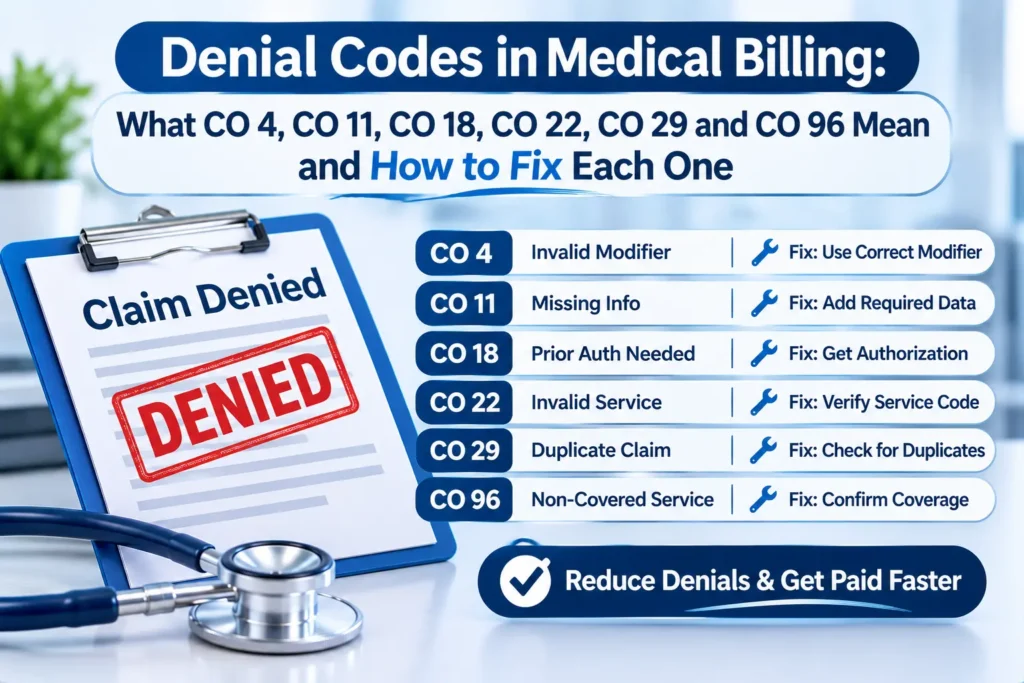
Denial codes in medical billing are the standardized Claim Adjustment Reason Codes (CARCs) a payer puts on your ERA or EOB to explain why it denied a claim or paid less than you billed. Every adjustment carries three pieces: a group code (CO, PR, OA or PI) that says who owns the balance, a CARC number that names the reason, and often a remark code (RARC) that adds the detail. Read all three before you touch the claim.
This guide covers the six codes that land on physician remits week after week: CO 4, CO 11, CO 18, CO 22, CO 29 and CO 96. You’ll also get the PR 1, PR 2 and PR 3 patient responsibility codes, a printable cheat sheet, and a simple rule for choosing between a corrected claim, an appeal and a write off.
If your practice bills more than 500 claims a month, a single misread code repeats itself hundreds of times before anyone notices. So start with the reading, then the fixing.
Key takeaways
- A denial code is always group code plus CARC number. CO 96 and PR 96 carry the same reason but put the balance on different people.
- Never bill the patient for an amount posted under group code CO. That’s a contractual obligation, and your payer contract usually forbids it.
- X12 says duplicate claims belong under OA 18, not CO 18. If you see CO 18, the payer is using a state workers’ compensation exception or posting it loosely.
- Medicare won’t hear a redetermination on a claim it denied for timely filing. Your only path on CO 29 is proof you filed on time or a regulatory exception.
- CO 4 and CO 11 are coding problems. CO 18 and CO 29 are billing workflow problems. CO 22 and CO 96 usually start at the front desk.
What are denial codes in medical billing?
Denial codes are the standardized reason codes payers use to explain why a claim or service line didn’t pay as billed. The official name is Claim Adjustment Reason Code, and the national standards body X12 maintains the full CARC list. Every HIPAA compliant 835 remittance uses the same code set, so a CO 4 from Aetna means the same thing as a CO 4 from your Medicare Administrative Contractor.
People say “denial code” loosely. Strictly, a CARC explains any adjustment, including routine ones like CO 45 (charge exceeds the fee schedule) or PR 2 (coinsurance). Only some CARCs mean the payer refused to pay. That distinction matters, because staff who treat every adjustment as a denial waste hours appealing amounts that were never disputed. Rejections follow a different path, and how a claim rejection differs from a denial decides which fix you use.
Two companion code sets travel with the CARC:
- Remittance Advice Remark Codes (RARCs) add the detail a CARC can’t carry. For CO 16 and CO 96, X12 requires at least one remark code on the remit. Codes starting with M, MA or N are RARCs.
- Claim Adjustment Group Codes sit in front of the CARC and assign financial responsibility. There are four in active use.
How do you read a denial code on an ERA or EOB?
Read it left to right: group code, then reason code, then remark code, then the dollar amount. A line on your 835 that reads CO 96 / N130 / 180.00 tells you the payer won’t cover 180 dollars, the provider owns that amount under the contract, and the plan’s benefit documents explain why.
Claim Adjustment Group Codes. X12 retired the fifth code, CR (Corrections and Reversals), for 005010 and later transactions, so you shouldn’t see it on a current remit.
Here’s the habit that saves the most money: sort your denials by group code first. A pile of PR adjustments is a patient collections task. A pile of CO adjustments is revenue you either recover or lose for good.
What do PR 1, PR 2 and PR 3 mean?
PR 1, PR 2 and PR 3 aren’t true denials. The payer processed the claim correctly and assigned part of the allowed amount to the patient’s cost share. Your job is to collect from the patient or bill the secondary plan, not to appeal.
One quick check catches most PR errors. If the PR 3 amount on the remit doesn’t match what your front desk collected, either the card on file is stale or the visit type changed the copay tier. Fix the eligibility record before the next visit, not after the statement goes out.
Common denial codes cheat sheet: CO 4, CO 11, CO 18, CO 22, CO 29 and CO 96
Print this table and pin it next to the billing desk. The X12 descriptions are the official wording; the rest is how our billers work each code.
Descriptions verified against the X12 CARC list, November 2026.
What does CO 4 mean in medical billing?
CO 4 means the payer found a mismatch between your procedure code and the modifier, or a required modifier is missing. The X12 wording is “The procedure code is inconsistent with the modifier used.” The provider owns the balance until you fix the claim.
Why CO 4 happens
- Modifier 25 is missing on an E/M service billed the same day as a minor procedure.
- Laterality is missing (RT, LT, or 50 for bilateral) on a procedure the payer requires to specify a side.
- Modifier 26 or TC is missing when the practice billed only the professional or technical component of a diagnostic test.
- Modifier 59 went on a code pair where the payer wants an X modifier (XE, XS, XP, XU) instead.
- The modifier is valid but sits in the wrong position, so the payer’s edit reads the pricing modifier as informational.
How to fix CO 4
Pull the chart and confirm the documentation supports the modifier you want to add. Then send a corrected claim with frequency code 7 and the original claim number in box 22 of the CMS 1500 (or loop 2300 on an 837P). Don’t file an appeal for a modifier fix. Medicare contractors often return CO 4 as unprocessable with remark code MA130, which carries no appeal rights at all, so an appeal just burns time.
If CO 4 shows up more than a few times a month on the same CPT code, you’ve got a coding rule problem, not a claim problem. Build the modifier into your charge entry template or your claim scrubber so it stops at the source.
What does CO 11 denial code mean?
CO 11 means the payer decided the diagnosis code on the claim doesn’t support the procedure billed. X12 describes it as “The diagnosis is inconsistent with the procedure.” You’ll often see remark code M76 (missing, incomplete or invalid diagnosis) alongside it.
Why CO 11 happens
- The ICD 10 CM code isn’t on the covered diagnosis list in the Local Coverage Determination (LCD) or National Coverage Determination for that service.
- The coder used an unspecified code when the payer’s policy requires a specific one, such as laterality or episode of care.
- Diagnosis pointers on the claim line point to the wrong diagnosis, so a knee X ray links to a hypertension code.
- A screening service went out with a diagnostic code, or the reverse.
How to fix CO 11
Start with the diagnosis pointers. They cause more CO 11 denials than most practices expect, and the fix takes 30 seconds. If the pointers are right, compare the documented diagnosis against the payer’s coverage policy. When the chart supports a more specific code, send a corrected claim. When the chart already supported the original code and the payer misapplied its policy, appeal with the note and the policy language.
Never change a diagnosis code just to get paid. If the documentation doesn’t support a covered diagnosis, the answer is a provider query or a write off, not a recode. That’s a compliance line, and payers audit for it.
Stop the Same Coding Denials From Coming Back
Seeing the same CO 4 and CO 11 denials every month? Those are coding patterns, and they’re fixable at the source. Our denial management services team traces each denial back to its root cause, corrects and resubmits the claim, and updates your scrubber rules so the same code stops coming back.
What is a CO 18 duplicate claim denial?
CO 18 means the payer already has a claim for the same patient, provider, date of service and procedure. The official description is “Exact duplicate claim/service.” Here’s the detail most guides miss: X12 says to use code 18 only with group code OA, except where state workers’ compensation rules require CO. So OA 18 is the textbook version, and CO 18 shows up mostly on workers’ comp remits or from payers that post loosely.
Why CO 18 happens
- A biller resubmitted a claim because it “hadn’t paid yet” instead of checking claim status first.
- A corrected claim went out as a new original claim (frequency code 1) instead of a replacement (frequency code 7).
- The clearinghouse sent the same batch twice after a connection error.
- Two providers in the same group billed the same service for the same encounter.
How to fix CO 18
Don’t appeal and don’t resubmit again. Check the status of the original claim through the payer portal or an electronic 276/277 status inquiry. If the original paid, post the payment and close the duplicate. If the original denied for another reason, work that denial instead. If you meant to send a correction, resend it as a replacement claim with frequency code 7 and the original claim number.
The real fix is a rule: nobody resubmits a claim younger than the payer’s processing window without a status check. Most practices that adopt it watch duplicate denials nearly disappear within a quarter.
What does CO 22 mean in medical billing?
CO 22 means the payer believes another plan should pay first under coordination of benefits (COB). X12 words it as “This care may be covered by another payer per coordination of benefits.” The payer isn’t refusing to cover the service. It’s refusing to go first.
Why CO 22 happens
- The patient has two plans (their own employer plan plus a spouse’s plan, for example) and you billed the secondary as primary.
- A Medicare patient still works for a large employer, so the group health plan pays first under Medicare Secondary Payer rules.
- The service relates to an auto accident or a workplace injury, and the payer expects the liability or workers’ comp carrier to pay first.
- The patient dropped a plan, but the payer’s COB file still lists it as active.
How to fix CO 22
- Run eligibility on every plan the patient has listed and confirm which one is primary.
- Bill the true primary payer first.
- Resubmit to the secondary payer with the primary payer’s EOB or ERA data attached. If you see remark code MA04, that’s exactly what Medicare is asking for.
- If the payer’s COB file is wrong, ask the patient to call their insurer and update it. Most payers won’t accept a COB update from the provider’s office.
Picture a Monday morning remit run at a four provider internal medicine practice in Tampa. Eleven CO 22 lines, all from one commercial plan, all patients who turned 65 that year. Nobody asked at check in whether they’d kept their employer coverage. One added question on the intake form (“Do you or your spouse still have coverage through work?”) fixes that whole category.
Can you appeal a CO 29 timely filing denial?
Sometimes, but only with proof. CO 29 means “The time limit for filing has expired.” You can overturn it if you can show the payer received the claim inside its window, or if a recognized exception applies. Without either, it’s a write off, and because it’s posted under CO, you can’t bill the patient.
What are the timely filing limits?
Medicare sets its 12 month limit in federal regulation 42 CFR 424.44, which also lists the narrow exceptions, such as an administrative error by Medicare or retroactive Medicare entitlement. Medicare treats a timely filing denial as not an initial determination, so it isn’t eligible for a redetermination. Don’t send a standard appeal for it.
How to fix CO 29
- Pull the clearinghouse acceptance report (the 999 and 277CA) or the payer’s electronic acknowledgment showing the original receipt date.
- If the original claim went to the wrong payer first, gather that payer’s denial with its date. Many commercial contracts reset the clock from that date.
- Send a reconsideration with the proof attached and a short cover letter citing the contract or regulation.
- If you have no proof and no exception, write it off and log the root cause.
A CO 29 is never really about the claim. It’s a symptom of a queue nobody watches. Run a weekly report of every unbilled or unpaid claim older than 60 days, sorted by payer filing limit, and the code goes quiet.
What does CO 96 non covered charge mean?
CO 96 means the payer won’t pay because the service isn’t covered. X12 labels it a non covered charge, and it requires at least one remark code with it. That remark code is the whole story, so never work a CO 96 without reading it.
Why CO 96 happens
- Nobody verified benefits for an elective or limited coverage service before the visit.
- The service is excluded by statute for Medicare (routine hearing exams, most cosmetic procedures) and the claim lacked the right modifier.
- The patient’s plan changed at the start of the year and the new plan excludes a service the old one covered.
How to fix CO 96
Read the remark code first. For Medicare patients, your ability to bill them depends on paperwork you completed before the service. A signed Advance Beneficiary Notice (ABN) plus modifier GA shifts liability to the patient for services Medicare may deny as not reasonable and necessary. Modifier GY flags a statutorily excluded service. Without the right notice or modifier, a CO 96 stays with the practice.
For commercial plans, the payer decides the group code. If it posts PR 96, you can bill the patient per your financial policy. If it posts CO 96, the contract usually holds you liable, so appeal only when you have documentation that the service is a covered benefit.
Corrected claim, appeal or write off: how do you choose?
Most wasted denial work comes from picking the wrong response. Use this rule of thumb before anyone opens a payer portal.
For Medicare, the first appeal level is a redetermination, and you have 120 days from receipt of the initial determination to file it. The Medicare Claims Processing Manual, Chapter 29 lays out each appeal level and its deadline. If an appeal is the right call, our guide to writing a medical claim appeal letter has a template you can copy.
How much do these denial codes cost a practice?
Run the math on your own numbers. Take a practice that sends 500 claims a month at an average of 150 dollars a claim. At a 12 percent denial rate, 60 claims and 9,000 dollars sit in rework every month. If a quarter of those never get worked before the filing window closes, that’s 2,250 dollars a month, or 27,000 dollars a year, written off under CO 29 alone.
The second cost is staff time. Every denial means someone reads the remit, pulls the chart, fixes the claim and tracks it again. That time comes straight out of follow up on everything else, which is how a denial problem quietly turns into an A/R problem.
Here’s our honest view: most practice managers overrate appeal win rates and underrate prevention. Four of the six codes in this guide (CO 18, CO 22, CO 29 and CO 96) start at the front desk or in the billing queue, not with the payer. You’ll recover more money by fixing intake and claim status habits than by writing better appeal letters.
How do you prevent the most common denial codes?
Assign every code to an owner, then fix the step where it starts.
At the front desk (CO 22, CO 96, PR 3)
- Run real time eligibility two business days before each visit and again at check in for new patients.
- Ask every patient over 64 whether they or a spouse still have employer coverage.
- Check benefits and collect a signed ABN or waiver before elective or limited coverage services.
Our insurance verification services run these checks before the patient arrives, so COB and coverage problems surface while you can still fix them.
In coding (CO 4, CO 11)
- Load payer specific modifier rules and LCD diagnosis lists into your claim scrubber.
- Audit 10 to 20 charts a month on your highest volume CPT codes.
- Send every CO 4 and CO 11 back to the coder who assigned it, with the remit attached. Feedback loops beat annual training.
If you don’t have a certified coder reviewing claims before submission, our CPC certified medical coding team can take that step over.
In the billing queue (CO 18, CO 29)
- Submit clean claims within a few days of the date of service.
- Ban resubmission without a status check.
- Work a weekly aging report sorted by each payer’s filing limit, not just by days in A/R.
- Save every clearinghouse acceptance report for at least as long as your longest filing limit.
What other denial codes should your billing team know?
These six aren’t the only codes on your remits. The ones below round out a working CARC codes list for most physician practices.
For the complete and current list, go to the source. X12 updates the CARC list several times a year, and payers adopt changes on their own schedules.
How does Medicotech handle denial codes?
Medicotech has processed more than 100,000 claims since 2020 for practices in 50 plus specialties across all 50 states, and we hold a 96 percent clean claim rate. We get there by treating every denial code as data. Each denied line gets a root cause tag (front desk, coding, billing or payer), and those tags feed back into the scrubber rules and intake scripts every month.
Denial management sits inside our full medical billing services, alongside charge entry, A/R follow up and patient statements, so the fix happens where the problem started.
Frequently asked questions about denial codes in medical billing
What are the most common denial codes in medical billing?
The codes physician practices see most include CO 16 (missing information), CO 4 (modifier mismatch), CO 11 (diagnosis doesn’t support procedure), OA 18 or CO 18 (duplicate), CO 22 (coordination of benefits), CO 29 (timely filing), CO 45 (fee schedule adjustment), CO 50 (medical necessity), CO 96 (non covered) and CO 97 (bundled service). Your own top 10 depends on your specialty and payer mix, so pull a 90 day CARC report to find yours.
What is the difference between CARC and RARC codes?
A CARC (Claim Adjustment Reason Code) states why a payer adjusted or denied a claim, such as CO 96 for a non covered charge. A RARC (Remittance Advice Remark Code) adds detail the CARC can’t carry, such as N130 pointing you to the patient’s benefit documents. Some CARCs, including 16 and 96, require at least one RARC.
What do PR 1, PR 2 and PR 3 mean?
PR 1 is the patient’s deductible, PR 2 is coinsurance, and PR 3 is the copayment. The PR group code means the patient owes the amount, not the practice. These aren’t true denials, so you bill the patient or a secondary payer instead of appealing.
Can I bill the patient for a CO denial?
No. Group code CO means a contractual obligation, so the provider owns the balance under the payer contract or a regulation. You can correct the claim, appeal it or write it off, but you can’t move it to the patient’s statement. Only PR adjustments go to the patient.
Is CO 18 or OA 18 correct for a duplicate claim?
OA 18 is the standard. X12 says reason code 18 should only go with group code OA, except where state workers’ compensation rules require CO. Either way, the fix is the same: check the original claim’s status and work that claim rather than resubmitting.
Can you appeal a CO 29 timely filing denial?
Only with proof that the payer received the claim on time, such as a clearinghouse 999 or 277CA acceptance report, or when a recognized exception applies. Medicare doesn’t allow a redetermination for timely filing denials. Without proof or an exception, the balance is a provider write off.
What is the difference between CO 96 and CO 50?
CO 96 means the service isn’t covered at all under the plan or by statute. CO 50 means the service can be covered, but the payer decided it wasn’t medically necessary for this patient. You fight CO 50 with clinical documentation; you handle CO 96 by reading the remark code and checking benefits.
Is a claim denial the same as a claim rejection?
No. A rejection happens before adjudication, usually at the clearinghouse or payer front end, because of a format or data error. The claim never enters processing, so you fix and resend it. A denial happens after the payer processes the claim and comes with a CARC on the remit.
How long do I have to appeal a Medicare denial?
You have 120 days from the date you receive the initial determination to file a redetermination, which is the first level of Medicare appeal. Commercial and Medicare Advantage plans set their own deadlines in your contract, and many are shorter.
Where can I find the full list of CARC codes?
X12 publishes the official Claim Adjustment Reason Code list on its website at x12.org, along with each code’s start date, any end date and usage notes. Check it whenever a remit shows a code you don’t recognize, because X12 adds and retires codes during the year.
See Where Your Denials Are Costing You
Denial codes tell you exactly where revenue leaks, but only if someone reads them in time. Book a free billing audit and a Medicotech denial specialist will review the last 90 days of your remits, group every denial by root cause, and show you which fixes recover the most money first. Start reducing denials this month.