
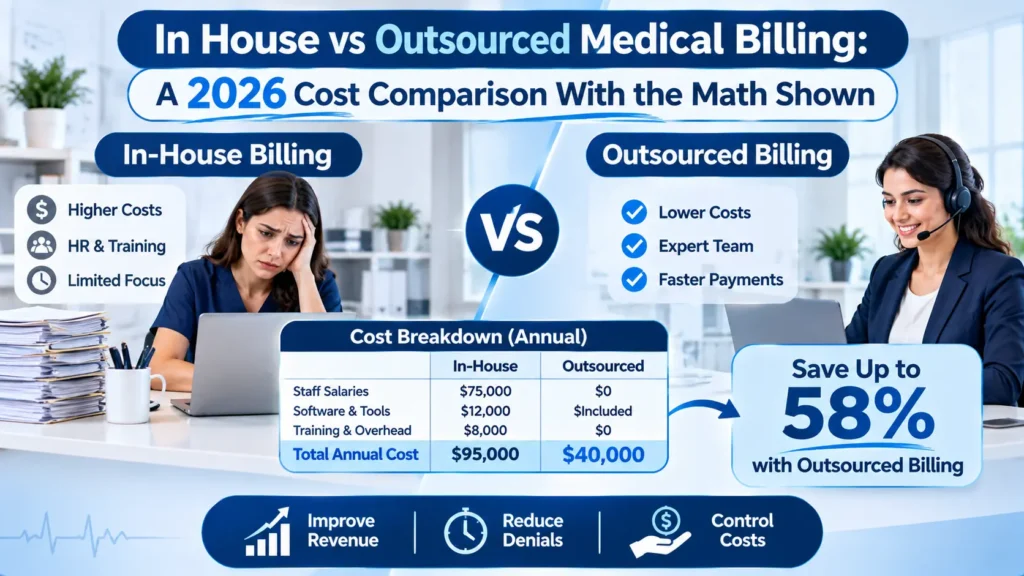
In house medical billing costs about $73,000 a year per biller in salary and benefits, before you buy any software. Outsourced medical billing costs 4 to 8 percent of what you collect. So the cheaper option depends on one number: how much each biller on your payroll collects. Under roughly $900,000 per biller, outsourcing wins on cost; over $1.8 million, in house usually does.
Those figures come from 2026 federal wage data, and we show every step below so you can swap in your own numbers. If your practice collects under $2 million a year with one or two billers, this comparison applies to you directly.
The 2026 Numbers at a Glance
- $51,140: median annual wage for medical records specialists, the closest federal benchmark for a certified biller or coder (BLS, May 2025).
- 30 percent: the share of private employer compensation costs that goes to benefits (BLS, June 2026).
- 4 to 8 percent of collections: the usual fee range for outsourced billing.
- $25.20: the average cost to rework one denied claim (MGMA).
- 40 percent: the share of providers who say payers deny 10 percent or more of their claims (Experian Health, State of Claims 2026).
- 2.31 percent: the cut to the Medicare conversion factor most physicians face in 2027 (CMS).
What’s the Difference Between In House and Outsourced Medical Billing?
In house medical billing means your own employees code visits, submit claims, post payments, and chase denials using software your practice pays for. Outsourced medical billing means a billing company does that work for a fee, usually a percentage of the money it collects for you.
How Much Does In House Medical Billing Cost Per Year?
One in house biller costs about $73,000 a year in wages and benefits. Software, clearinghouse fees, training, and turnover push the real figure higher. Here’s how we get there.
The Bureau of Labor Statistics reports a median wage of $51,140 for medical records specialists, or $24.59 an hour. Wages aren’t the whole bill, though. The BLS employer compensation cost report for June 2026 shows wages make up 70 percent of what private employers spend on a worker. Benefits and payroll costs make up the other 30 percent.
Divide $51,140 by 0.70 and you get $73,057.
We left three rows open on purpose. Most guides fill them with round numbers and no source. Pull your last 12 months of invoices instead. It takes about 20 minutes, and you’ll trust the answer.
One caution: wages vary by market, so use your actual payroll figure if you have one.
How Much Does Outsourced Medical Billing Cost in 2026?
Most billing companies charge 4 to 8 percent of collections, and a few advertise rates under 3 percent for high volume, low complexity work. Our own quotes fall inside that 4 to 8 percent band. On $1 million in annual collections, a 6 percent fee comes to $60,000 a year, or $5,000 a month.
Four things move your rate: specialty, monthly claim volume, average claim value, and scope. A behavioral health practice with many low dollar claims pays a higher percentage than an orthopedic group with fewer, larger ones.
Medicotech charges a percentage of collections with no setup fee. We prefer that model for a plain reason: we earn nothing on a claim until the payer pays you. Our outsourced medical billing services page explains what the service covers.
In House vs Outsourced Medical Billing: Which Costs Less at Your Practice Size?
Outsourcing costs less when each of your billers supports under about $900,000 in annual collections. In house costs less on labor once each biller supports more than about $1.8 million. Between those two figures, your fee rate decides it.
Here’s the formula:
- At an 8 percent fee: $73,057 ÷ 0.08 = about $913,000
- At a 6 percent fee: $73,057 ÷ 0.06 = about $1.22 million
- At a 4 percent fee: $73,057 ÷ 0.04 = about $1.83 million
Now apply it to three example practices. These are models built from the BLS figures above, and they count labor only.
Look at the first row. The two provider practice spends 12.2 percent of collections on one biller and would spend 6 percent on a vendor. That’s $37,057 a year back in the practice.
The third row tells the opposite story. A ten provider group with three productive billers pays 5.5 percent in labor, less than a 6 percent fee. Any guide that says outsourcing always saves money hasn’t done this arithmetic.
Our billing support for small practices exists because the math favors the small end so clearly.
Keep in mind what the table leaves out. Add your software and clearinghouse invoices to the in house column and every break even point moves in outsourcing’s favor.
Close to the Break Even Line?
That’s common for practices with one or two billers, and cost alone won’t settle it. Our medical billing team works inside your current EHR and charges a percentage of collections with no setup fee, so our fee rises and falls with your revenue. See how the service works before you decide anything.
What Costs Does Neither Price Tag Show?
Salary and fee percentage are the visible costs. The larger number is what your billing process fails to collect, and it applies to both models.
Denial rework
MGMA puts the average cost to rework a denied claim at $25.20. Say you submit 500 claims a month and payers deny 10 percent. That’s 50 denials, $1,260 a month in rework labor, and $15,120 a year. You pay that before you recover a dollar, which is why dedicated denial followup pays for itself faster than almost anything else in the revenue cycle.
The one biller problem
Picture a two provider Internal Medicine practice in Tampa with one biller. She takes two weeks off in July. Nobody works the CO-97 bundling denials or the CO-16 requests for missing information, and every payer’s timely filing clock keeps running. By the time she’s back, 10 working days of ERAs sit unposted.
Nothing went wrong there. That’s just what a team of one looks like.
One point of net collections
On $1.5 million in collections, one percentage point of net collection rate equals $15,000 a year. A vendor that charges one point more but collects two points more is the cheaper vendor.
Most practice managers compare the fee to a salary. We think that’s the wrong comparison. Put the fee next to salary plus the revenue your current process leaves uncollected.
Not sure whether a payer rejected or denied a claim? Start with our guide to how rejections differ from denials, because each one needs a different fix.
What Changed in 2026 That Affects This Decision?
Three developments this year raise the cost of running billing with a small team: a Medicare pay cut, new prior authorization rules, and denial rates that refuse to fall.
Medicare will pay less per service in 2027
CMS released the 2027 Physician Fee Schedule final rule on November 4, 2026. For clinicians outside an advanced alternative payment model, the conversion factor falls from $33.40 to $32.63, a 2.31 percent cut. A practice with $400,000 in Medicare fee schedule revenue loses roughly $9,240 for the same work, before any RVU changes.
Your biller’s salary won’t fall 2.31 percent. A percentage fee will.
Prior authorization moved to faster clocks and new systems
Under the CMS Interoperability and Prior Authorization final rule, Medicare Advantage, Medicaid, and CHIP plans have had to answer standard requests within 7 calendar days and urgent ones within 72 hours since January 2026. Those payers must also bring electronic prior authorization APIs online starting January 2027. Somebody has to learn each payer’s new workflow. A solid eligibility and benefits verification process catches most pre authorization gaps before the visit.
Denials haven’t improved
Experian Health surveyed 204 revenue cycle staff in August 2026. Forty percent said payers deny at least one claim in ten, nearly the same as 41 percent in 2025 and well above 31 percent in 2022. In the same survey, 78 percent said payer policies change more often than they used to. One person can’t track rule changes at BCBS, Aetna, UHC, Cigna, and Humana while also posting payments.
What Are the Pros and Cons of Outsourcing Medical Billing?
Outsourcing trades direct control for lower fixed cost and deeper staffing. In house billing trades higher fixed cost for a person down the hall.
Outsourced billing: pros
- Cost falls when collections fall, so a slow month doesn’t squeeze you twice.
- A team covers vacations, sick days, and resignations.
- You get coders and A/R specialists you couldn’t afford to hire one by one.
- The vendor sees payer behavior across many practices and spots denial patterns sooner.
- On a percentage model, the vendor only earns when you do.
Outsourced billing: cons
- You can’t walk down the hall and ask about a claim.
- Quality varies widely between vendors, and a bad one is hard to see for 60 to 90 days.
- As collections grow, the fee grows with them.
In house billing: pros
- Your biller knows your providers, your patients, and your documentation habits.
- You control priorities hour by hour.
- Past a certain size, labor cost per dollar collected drops below any vendor’s fee.
In house billing: cons
- Payroll stays fixed when patient volume drops.
- One resignation can stall your cash flow for weeks.
- You pay for software, clearinghouse fees, and training on top of salary.
- Your practice carries the full burden of tracking payer and CMS rule changes.
Should I Outsource Medical Billing? A 6 Question Test
Outsource if you answer yes to three or more of these. If you answer yes to one or none, your in house setup probably works, and you should protect it.
- Does each biller on your payroll support less than $900,000 in annual collections?
- Do payers deny more than 5 percent of your claims on first submission?
- Do your days in A/R run above 40?
- Would billing slow down or stop if one specific person left tomorrow?
- Has your billing team turned over in the last 18 months?
- Are you unsure of your clean claim rate right now?
That last question matters more than it looks. A practice that can’t state its clean claim rate can’t judge its own billing, whoever does the work. Ours runs at 96 percent.
When does in house billing make more sense?
Keep billing in house if you have three or more billers, a manager who reviews denial reports weekly, a first pass rate above 95 percent, and days in A/R under 35. A vendor would have to beat those numbers, and few will. Consider outside help only for narrow jobs such as old A/R cleanup or a yearly revenue cycle management review.
What Should a Billing Contract Say Before You Sign?
The contract decides your real cost more than the headline percentage does. We think the fee gets too much attention and the definition of collections gets too little. Check these seven terms.
- Definition of collections. Does the percentage apply to copays your front desk collects at check in? It shouldn’t, unless the vendor runs patient billing too.
- Monthly minimums. A minimum fee turns a variable cost back into a fixed one.
- Scope. Confirm that appeals, old A/R, patient statements, and eligibility checks fall inside the fee.
- Software and clearinghouse charges. Ask whether the vendor bills these to you separately.
- Data ownership. You should keep full access to your practice management system and own every record.
- Termination. Look for 30 to 60 days’ notice and a clear plan for claims already in process.
- Reporting. Require monthly reports on clean claim rate, denial rate by payer, days in A/R, and net collection rate.
How Do You Switch Without a Cash Flow Dip?
Plan the handoff around your existing claims, because that’s where the dip comes from. Budget one to two billing cycles and follow four steps.
- Keep your EHR. Changing billing vendor and software at the same time doubles the risk. A good vendor works in whatever system you already run.
- Set a clean cutover date. The vendor takes every date of service from that day forward.
- Assign the old A/R. Decide in writing who works claims from before the cutover. Unowned A/R ages out.
- Compare at day 90. Measure denial rate, days in A/R, and collections against your baseline from the three months before the switch.
The Bottom Line
Run the formula first. Divide your loaded cost per biller by the fee your vendor quoted, then compare the result to what each biller collects. If the answer is close, let denial rate and days in A/R decide. Either way, you now have the arithmetic to check anyone’s sales pitch, including ours.
Frequently Asked Questions
Is it cheaper to outsource medical billing or keep it in house?
Outsourcing is cheaper for most small practices. One biller costs about $73,000 a year in wages and benefits, based on 2026 BLS data. A 6 percent fee on $600,000 in collections costs $36,000. In house becomes cheaper on labor when each biller supports more than about $1.2 million in collections at that fee rate.
How much does outsourced medical billing cost per month?
Multiply your monthly collections by the fee rate. A practice that collects $100,000 a month pays $4,000 to $8,000 at the usual 4 to 8 percent range. Ask whether the quote covers appeals, patient statements, and clearinghouse fees.
What does a medical billing company’s percentage include?
A full cycle fee should cover charge entry, coding review, claim scrubbing and submission, payment posting, denial appeals, A/R followup, and monthly reporting. Credentialing, old A/R cleanup, and patient call handling often cost extra. Get the scope in writing, because two vendors quoting 6 percent can mean very different workloads.
Do I have to change my EHR to outsource billing?
No. A capable billing company logs into your existing EHR and practice management system. Medicotech works inside the software our clients already use, including Epic, athenahealth, AdvancedMD, eClinicalWorks, DrChrono, and Kareo (Tebra).
How long does it take to switch from in house to outsourced billing?
Plan for one to two billing cycles. The vendor needs system access, updated EDI and ERA enrollment with your payers, and a cutover date. Judge the results at 90 days, after claims from the new process have paid or gone through denial followup.
Is outsourced medical billing HIPAA compliant?
It is when you sign a business associate agreement with the vendor, which HIPAA requires before the vendor touches patient data. Ask for that agreement before you share any system access. Medicotech is HIPAA compliant.
Which billing model is easier to budget for?
In house billing gives you a steadier monthly expense, since payroll rarely changes. Outsourced billing gives you a steadier margin, since the fee rises and falls with collections. If your patient volume swings by season, the percentage model protects cash in slow months.
Can a small practice keep one biller and outsource the rest?
Yes, and many do. A common split keeps one employee on charge entry, patient questions, and front desk collections while a vendor handles claim submission, denial appeals, and A/R followup. Define who owns each task in the contract so no claim falls between the two.
What do I still handle after outsourcing?
Your practice still collects copays at check in, verifies demographics, finishes clinical documentation on time, and answers the vendor’s coding questions. The practice remains responsible for every claim that goes out under its NPI.
Not Sure Which Side of the Line You Are On?
Send us your last 90 days of claims. A Medicotech billing specialist will calculate your denial rate and days in A/R, then show you both options side by side. You pay no setup fee and sign no contract to see the results.
About the authors. The Medicotech Billing Team includes CPC certified billers and coders based in St. Petersburg, Florida. Since 2020 we’ve handled billing for practices in 50 plus specialties across all 50 states.