
Hospital Privileging Services
We get your providers privileged to practice at hospitals and facilities, from the initial medical staff application through re-privileging and OPPE tracking, so they can treat patients without a gap.

What are Hospital Privileging Services?
Hospital privileging services manage the process of getting a provider approved to practice at a specific hospital or facility, including exactly which procedures they’re authorized to perform. The work covers the medical staff application, primary source verification, delineation of privileges, the governing body approval, and the ongoing OPPE and FPPE monitoring that keeps privileges active. A provider needs privileging at every facility where they want to treat patients.
This is the step that sits between being licensed and actually working in a hospital. You can be fully credentialed and in network with every payer, and still not be allowed to admit a patient or perform a procedure at a given hospital until that facility privileges you. Privileging is the facility’s call, and it’s specific, detailed, and ongoing.
Hospital Privileging vs Payer Credentialing, What's The Difference?
This is the question that trips up most providers, so it’s worth being clear. The two sound alike and overlap on paperwork, but they’re different processes with different approvers and different goals.
- Payer credentialing gets you approved by an insurance company so you can bill and get paid. The approver is the payer. That work lives on our insurance credentialing services page.
- Hospital privileging gets you approved by a facility to practice there and perform specific procedures. The approver is the hospital’s governing body. That’s this page.
A provider usually needs both, and they run on separate tracks. Being in network with a payer does nothing for your hospital privileges, and being privileged at a hospital doesn’t get you paid by insurers. We handle privileging here and coordinate it with the rest of your medical credentialing so the two stay in sync.

What Are The Types Of Hospital Privileges ?
Privileges aren't one size. A facility grants different levels depending on what a provider does there, and the application has to request the right ones. The main types:

We map your request to the right mix of these, because asking for the wrong privileges, or too broad a set, is a quick way to get an application sent back.
How does the hospital privileging process work?
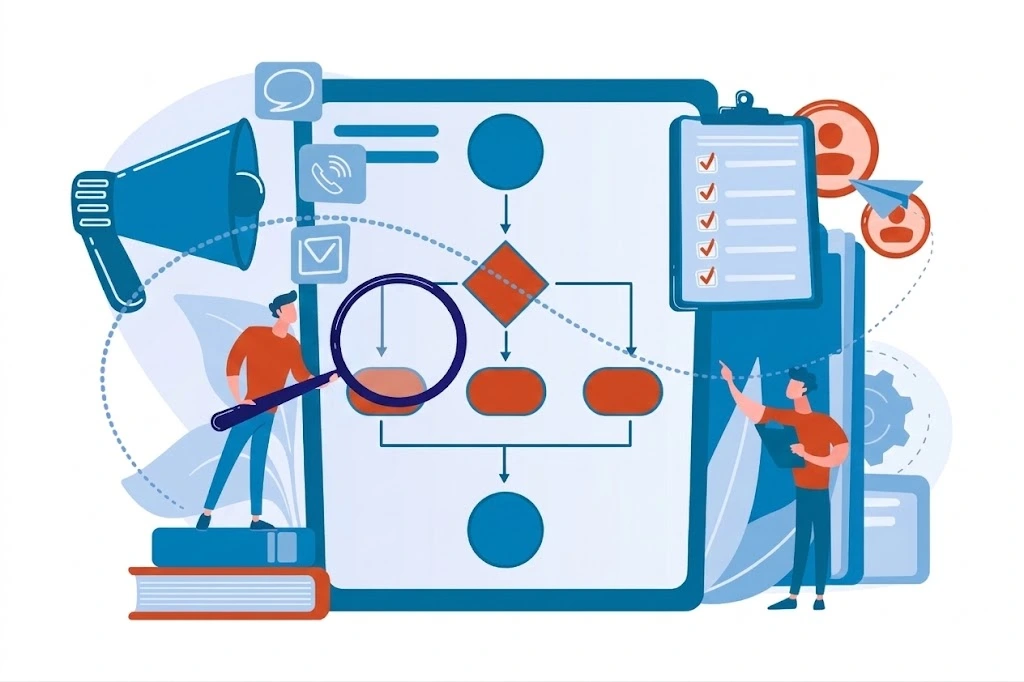
Privileging runs through a defined sequence, and each facility has its own committee schedule layered on top. Here's how we manage it.
Application & Document Collection
We complete the medical staff application and gather the supporting file: license, DEA, board certification, malpractice history, education and training, and the specific procedure list the provider is requesting.
Delineation of Privileges
We map exactly which privileges the provider is requesting, by procedure, against the facility's privilege list, so the request is precise and matches their training and experience.
Primary Source Verification
The facility verifies credentials directly with the source, including state boards, the NPDB for malpractice and sanctions, and education and training records.
Committee Review & Approval
The application moves through the clinical department, the credentials committee, and the medical executive committee, then to the governing body, which holds the only authority to grant privileges under CMS rules.
FPPE and Ongoing OPPE
New privileges trigger a Focused Professional Practice Evaluation, and from there the provider is monitored through Ongoing Professional Practice Evaluation, which feeds the next re-privileging cycle.
What Hospital Privileging Covers
Privileging isn't a single event, it's an initial approval plus a lifecycle of maintenance. Here's what we handle, and these are areas we'll expand into dedicated guides as questions get more specific.
Initial Hospital Privileging
The first time a provider seeks privileges at a facility, from medical staff application through governing body approval. This is the heaviest lift, because it carries the full primary source verification and the first FPPE. We manage the application end to end and time it to the facility's committee calendar so it doesn't miss a meeting.
Re-Privileging Services
Privileges aren't permanent. The Joint Commission requires re-privileging no later than every three years, and many facilities run a two-year cycle. We track every facility's renewal date, compile the OPPE data and updated documents, and submit ahead of the deadline so a privilege never lapses and the provider keeps practicing without interruption.
Medical Staff Application
The medical staff application is detailed and facility-specific, and a small omission sends it back. We complete it accurately, attach the right supporting documents, and manage the correspondence with the medical staff office so the file keeps moving through each review layer.
Facility Credentialing
Beyond individual providers, facilities themselves need credentialing, and organizations need a consistent process for privileging their medical staff. We support facility level credentialing and help build the repeatable workflow that keeps a medical staff office on top of applications, renewals, and compliance.
Delineation of Privileges
Delineation is the precise list of what a provider may do, defined by procedure rather than broadly by specialty. Getting it right protects both the provider and the facility, since a provider can't perform a procedure they aren't privileged for. We map the request carefully against the provider's training and the facility's privilege library.
Hospital Affiliation Management
Providers who practice across multiple hospitals carry a separate privileging file at each one, with different cycles and committees. We manage those affiliations in parallel, keep each file current, and make sure no facility's renewal slips through the cracks.
Common Hospital privileging Challenges, and How We Solve Them

| Challenge | Why it happens | How we solve it |
|---|---|---|
| Missed committee cycle | Application isn't ready before the monthly committee meeting | Clean, complete file timed to the committee calendar |
| Privileges don't transfer | Each facility requires its own separate privileging | Parallel file management across every facility |
| Imprecise delineation | Requested privileges don't match training or the privilege list | Careful procedure-level delineation mapping |
| Lapsed re-privileging | The two or three year renewal date is missed | Central cycle tracking, submitted ahead of the deadline |
| Weak OPPE or FPPE data | Performance data isn't compiled or is incomplete | Data compiled and tracked for each evaluation |
| Stalled verification | Primary source verification hits a gap or a slow source | Active follow-up with sources and the medical staff office |
The honest reality: privileging is slow by design, because a hospital is deciding who gets to operate inside it. You can't shortcut a governing body. What you can do is file a clean, complete, precisely delineated application that doesn't give a committee a reason to table it for another month, and that single discipline saves more time than anything else.
What Does Hospital Privileging Cost?
Transparent, flat pricing. No mystery rate cards.
Per Facility Privileging
A flat fee per provider, per facility, for the initial privileging application.
Re-Privileging Services
A lower flat fee per renewal cycle keeping records consistently updated.
Multi-Facility & Locum
Quoted by the number of facilities and providers, since the work scales with parallel files.
Transparent Models
No setup fees. Month-to-month flexibility with a free privileging audit first.
We quote the exact number after a free review of your providers, the facilities involved, and where each privileging file stands.
Hospital privileging is one service in a larger program. It’s part of our medical credentialing services, and it works alongside physician credentialing for the provider lifecycle, insurance credentialing for payer paneling, provider enrollment for Medicare and Medicaid, and re-credentialing for renewals. Aligning privileging with payer credentialing is what lets a new provider start treating patients and billing at the same time, instead of being privileged but unpaid, or paid but unprivileged.
Privileging As Part Of Your Full Credentialing Program

Provider Enrollment FAQs
What are hospital privileging services?
Hospital privileging services manage the process of getting a provider approved to practice at a specific hospital or facility, including which procedures they’re authorized to perform. The work covers the medical staff application, primary source verification, delineation of privileges, the governing body approval, and the ongoing OPPE and FPPE monitoring that keeps privileges active. Privileging is separate from payer credentialing, and a provider needs it at every facility where they want to treat patients.
What is the difference between hospital privileging and credentialing?
Credentialing verifies a provider’s qualifications. Privileging is the facility’s decision about what that provider is allowed to do inside its walls, which procedures and which level of care. Payer credentialing gets you paid by insurers; hospital privileging gets you the right to practice at a hospital. They’re different processes with different approvers, and a provider usually needs both. We handle the privileging side and coordinate it with the rest of credentialing.
Do hospital privileges transfer between facilities?
No. Privileges are facility specific. A provider privileged at one hospital must complete a separate privileging process at every other facility where they want to practice, even within the same health system and even if they’re already in network with the same payer. This is why providers working across multiple hospitals carry several privileging files at once, which is exactly the kind of tracking we manage.
What are the types of hospital privileges?
Privileges generally fall into three categories. Admitting privileges let a provider admit patients to the hospital under their own name. Surgical privileges authorize specific procedures, delineated by procedure type rather than broadly by specialty. Courtesy privileges let a provider occasionally treat or admit patients at a hospital where they aren’t primary staff. The exact delineation varies by facility and specialty, which is why the application has to be precise.
What are OPPE and FPPE?
OPPE, Ongoing Professional Practice Evaluation, is the continuous monitoring of a privileged provider’s performance, things like complication rates and documentation quality. FPPE, Focused Professional Practice Evaluation, is a more intensive, time limited review triggered when a provider first gets a privilege, requests a new one, or when a quality concern arises. The Joint Commission requires both. We help compile and track the data that feeds them so re-privileging goes smoothly.
How often is re-privileging required?
The Joint Commission requires re-privileging no later than every three years from the previous appointment, and many facilities run a two year cycle. State law can require a shorter one. At re-privileging, the hospital reviews the provider’s OPPE data, any FPPE results, current licensure, malpractice history, and NPDB query results before renewing, modifying, or denying privileges. We track every facility’s cycle so a privilege never lapses.
Who grants hospital privileges?
Under CMS Conditions of Participation, only the hospital’s governing body has the authority to grant clinical privileges. The application moves through several review layers first, the relevant clinical department, the credentials committee, and the medical executive committee, before the governing body makes the final decision. We prepare and manage the application so it moves cleanly through each layer.
How long does hospital privileging take?
Initial privileging typically takes 90 to 120 days, depending on the facility’s committee schedule and how complete the application is. The biggest delays come from incomplete applications, missing primary source verification, or gaps that trigger follow up questions. Because committees often meet monthly, missing one meeting can add weeks, so a clean, on time submission matters. We file complete to avoid missed committee cycles.
Do you handle privileging for ambulatory surgical centers and locum providers?
Yes. Ambulatory surgical centers, surgical hospitals, and locum tenens providers all need facility privileging, and locums especially need it fast and often across multiple sites. We manage privileging for hospitals, ASCs, surgical facilities, and locum providers, including the parallel tracking that multi facility and locum work requires.
Is Medicotech HIPAA compliant?
Yes. Every Medicotech privileging specialist signs a HIPAA business associate agreement. Provider documents are handled in encrypted systems with role based access, and we keep audit logs of every submission. HIPAA is a regulation we comply with, not a certification anyone issues.
Ready to get your providers privileged and practicing?
Send us your provider list and the facilities involved. We'll audit where each privileging file stands, flag missing documents and approaching committee deadlines, and give you a realistic timeline to approved privileges. Free, no commitment.
Prefer email? hello@medicotechllc.com
Testimonials From Our Valued Clients
Posted on GoogleTrustindex verifies that the original source of the review is Google. Professional, responsive, and knowledgeable medical billing team. They have been a great support for our practiceLoad more