

Anesthesia RCM is the full financial lifecycle of an anesthesia case, from eligibility checks and chart capture through coding, claim submission, payment posting, denial follow-up, and patient balances. It works differently than almost any other specialty because payers reimburse for time as well as the procedure code. Get the minutes, the modifier, or the medical direction record wrong, and the claim can underpay or deny. Practices can also benefit from specialized anesthesiology billing services to improve coding accuracy, claim submission, and reimbursement.
The pressure on that process keeps growing. CMS split the 2026 anesthesia conversion factor into two tiers, one for qualifying APM participants and one for everyone else. Then on July 14, 2026, CMS proposed a lower anesthesia conversion factor for 2027 ( ASA’s summary of the 2027 proposal). If the final rule keeps that cut, each unit pays less next year, so every lost case and every rounding error costs your group more.
If your group bills more than 300 cases a month, this applies to you. We wrote this guide for practice managers and group administrators, not coders, so you get the logic first and the unit math second. You’ll learn how anesthesia revenue cycle management works, where the money leaks, which numbers to watch, and how to decide between running it in house and handing it off.
What is anesthesia revenue cycle management?
Definition Anesthesia revenue cycle management is the set of administrative and financial steps that turn anesthesia care into collected revenue. It starts when the surgical team books the case and ends when the payer and the patient have paid every dollar owed. In between, your team verifies coverage, captures the anesthesia record, codes the case, submits the claim, posts payments, works denials, and bills patient balances.
People also search for anesthesiology revenue cycle management and anesthesiology RCM. Same cycle, different wording.
Anesthesia billing is one step inside that cycle, and vendors blur the two terms constantly. A billing only vendor submits claims and posts payments. A full cycle partner also owns eligibility, enrollment, case reconciliation, denial recovery, and reporting. Our anesthesiology billing services cover the claim and payment side and connect to every other stage.
Why does anesthesia need its own playbook? Payers price each case by the clock. The provider’s role can cut the payment in half.
And the data you need lives in an anesthesia record that rarely matches the surgical record line for line. A general medical biller can code a clean claim and still lose money here.
What are the stages of the anesthesia revenue cycle?
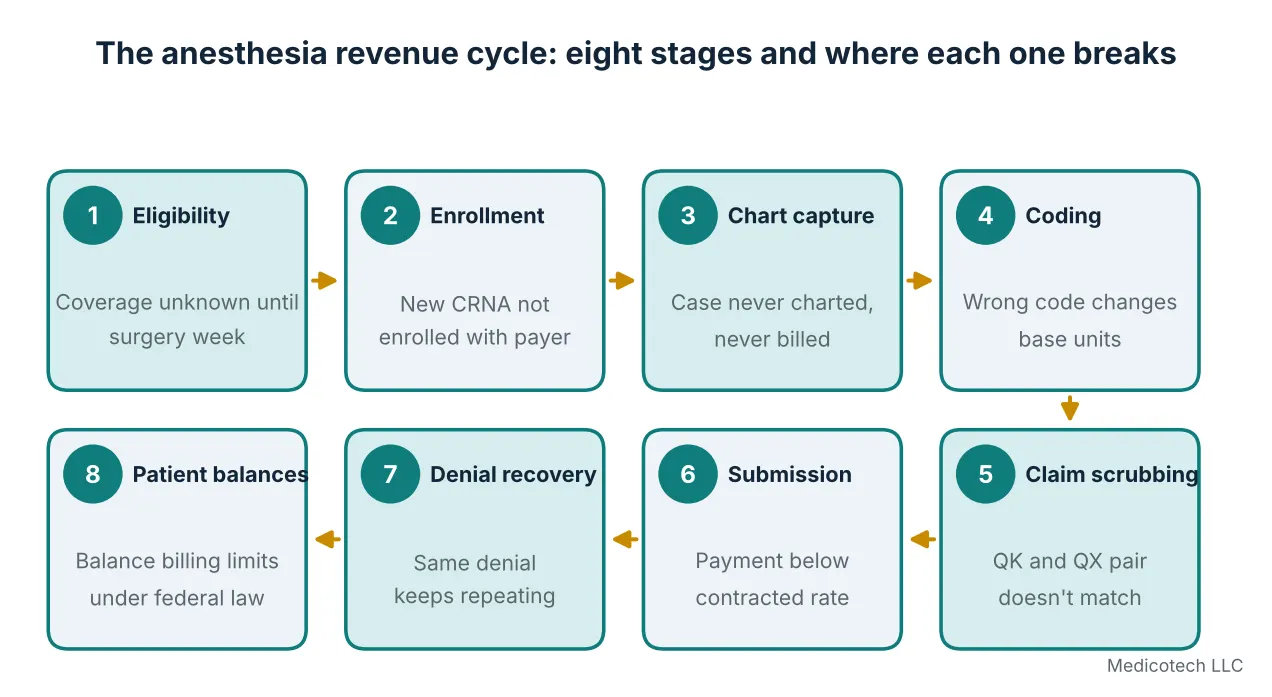
The anesthesia revenue cycle runs through eight stages: eligibility, enrollment, chart capture, coding, claim scrubbing, submission and posting, denial recovery, and patient collections. Each stage has its own failure point, and anesthesia adds a few that other specialties never see.
- Eligibility and authorization. Patients rarely choose their anesthesia group, so you often learn their coverage the week of surgery. Teams that verify eligibility before the case catch inactive plans and pre authorization gaps while there’s still time to fix them.
- Enrollment and credentialing. A new CRNA who isn’t enrolled with a payer produces claims that deny or pay late. Start enrollment the day a provider signs, not the day they take a first case.
- Chart and time capture. Pull start and stop times, provider roles, and the procedure from your anesthesia information management system (AIMS) or hospital EHR, such as Epic or Cerner. Then reconcile every case on the OR schedule against a charted anesthesia record. If nobody charts a case, nobody bills it.
- Coding. Coders pick the anesthesia CPT code (00100 through 01999), attach the payment modifier, and add physical status modifiers P1 through P6 and qualifying circumstances where the payer recognizes them. A wrong code changes the base units, which changes the payment.
- Claim scrubbing. Check modifier pairs, time format, concurrency limits, and place of service before the claim leaves your building.
- Submission and posting. Send the claim electronically on the 837P, then post each ERA line and compare payment per unit against your contracted rate. Underpayments hide in this step.
- Denial and underpayment recovery. Work denials by root cause, not claim by claim, and attach the anesthesia record to every appeal. A dedicated denial management team turns recurring denials into rule changes upstream.
- Patient balances. Anesthesia patients often owe only a deductible or coinsurance share, and federal rules limit what you can bill them. The No Surprises Act section below covers the details.
How is anesthesia reimbursement calculated?
Payers calculate anesthesia payment by adding base units, time units, and any modifying units, then multiplying the total by a conversion factor. Base units come from the anesthesia CPT code. Time units come from your documented minutes, at 15 minutes per unit for Medicare. The conversion factor changes by payer and locality.
Every anesthesia code carries its own base units, so a coding error changes the payment before time even enters the formula (our walkthrough of how one common colonoscopy anesthesia code pays shows the effect).
Medicare’s 2026 national anesthesia conversion factor is 20.4976 dollars per unit for standard clinicians and 20.5998 dollars for qualifying APM participants, before locality adjustments (the CMS Anesthesiologists Information Center posts current rates). Locality moves the number. In Florida, participating physician rates run from 21.05 to 22.69 dollars per unit across Medicare localities in 2026 ( the 2026 Florida rate table). Commercial payers set their own rates by contract, and those rarely match Medicare.
What does one case look like in dollars?
Take CPT 01402, anesthesia for a total knee replacement. It carries 7 base units. Your anesthesiologist documents 129 minutes of anesthesia time, which equals 8.6 time units.
That makes 15.6 units. Multiply by the 2026 national conversion factor and Medicare allows 319.76 dollars before locality adjustment.
Now add a CRNA under medical direction. Medicare splits that allowance in half. The physician receives 159.88 dollars, and the CRNA or anesthesiologist assistant receives 159.88 dollars. Watch who bills what, because the pair falls out of sync more easily than you’d think.
Here’s a small leak: round those 129 minutes down to 120 and you lose 0.6 units, about 12 dollars. Nobody notices that on one claim. Multiply it across 400 cases a month and you lose roughly 4,900 dollars. The scenario is an illustration, but the arithmetic is real.
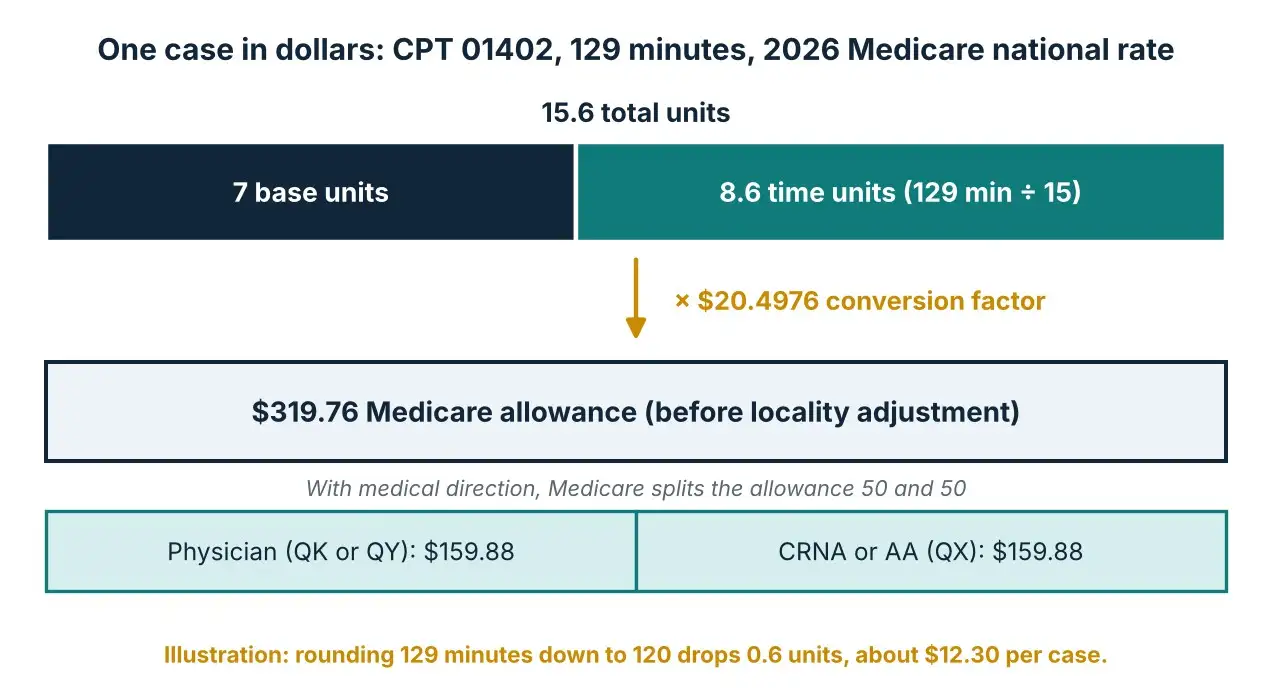
Unit math for one medically directed case at the 2026 national Medicare conversion factor, before locality adjustment.
Optimize Your Anesthesia Billing Performance
Small time and modifier errors rarely look expensive on a single claim, but they compound across hundreds of cases a month. Our anesthesia billing specialists audit time units, modifier pairs, and documentation before each claim goes out, which improves reimbursement without adding work for your staff. Talk with our team about what a review of your recent claims would find.
Why do anesthesia claims deny or underpay?
Anesthesia claims deny or underpay most often because of five fixable problems: wrong or missing time, mismatched physician and CRNA modifiers, thin medical direction records, concurrency errors, and eligibility or enrollment gaps. None of them needs a clinical fix. All of them need a billing process that checks the claim before the payer does.
Time errors. Payers compare your minutes against the facility’s record. When the start and stop times differ by a few minutes, or when you report a break as continuous time, the claim pays wrong or denies.
Modifier mismatches. The physician bills QK or QY. The CRNA bills QX. If either side picks the wrong modifier, the payer sees two claims that don’t agree and denies one or reduces both.
Thin medical direction records. Medicare pays the medically directed rate only when the physician completes seven specific activities for each patient, including the pre anesthetic evaluation, the anesthesia plan, and personal participation in induction and emergence. Six out of seven isn’t medical direction, and an auditor will say so.
Concurrency errors. Medical direction covers two to four concurrent cases. Cross that line and the physician’s modifier changes to AD, which pays three base units plus one time unit when the physician attends induction (see Chapter 12 of the Medicare Claims Processing Manual). Track concurrency against the OR schedule, because the anesthesia record alone hides the overlap.
Eligibility and enrollment gaps. A patient who changes plans the week of surgery, or a new provider the payer hasn’t enrolled, produces a denial that no coder can fix after the fact.
Six payment modifiers tell Medicare who did what. Learn them, because every mismatch above traces back to this table.
Picture an ambulatory surgery center group with two anesthesiologists and six CRNAs. It bills 400 cases a month at an average allowed amount near 320 dollars. If 12 percent of those cases deny on first pass, 48 cases and about 15,400 dollars sit in rework every month. That’s an illustration, not a client result, but the math holds for any group with similar volume.
We fix these problems upstream. Medicotech scrubs every anesthesia claim for modifier pairs, time format, and concurrency before submission, checks all seven direction elements on medically directed cases, and routes every rejection to a specialist. Across the 200 plus anesthesia and pain management providers we bill, our accounts post a 97 percent net collection rate. For the broader version of this discipline, read the general denial prevention playbook.
How does the No Surprises Act affect anesthesia payments?
For most commercial plans, the No Surprises Act bars you from balance billing patients for out of network anesthesia at an in network facility. You collect from the plan, and the patient owes only the in network cost share. If the plan underpays, you can dispute the amount through open negotiation and the federal independent dispute resolution (IDR) process.
Anesthesia sits on the short list of ancillary services the law covers, because patients almost never choose their anesthesia provider. Emergency anesthesia gets the same protection at any facility. Medicare and Medicaid claims fall outside this law and follow their own rules.
Treat open negotiation as a deadline, not a courtesy. The 30 business day window to dispute an underpayment starts when you receive the initial payment or denial, and missing it can close the door on IDR. Rules and procedures have changed since 2022, so confirm current requirements on the CMS No Surprises Act page before you build your workflow.
Which anesthesia RCM metrics should you track every month?
Track seven numbers every month: case capture rate, first pass rate, denial rate, days in A/R by payer, payment per unit against contract, charge lag, and net collection rate. Together they show where cases disappear, where claims stall, and where payers underpay.
These are working targets, not industry standards. Adjust them for your payer mix, and run every number by payer and by provider rather than only in total. A healthy overall anesthesiology payment collection rate can hide one payer that underpays every QK claim.
Most groups overrate contract negotiations and underrate case reconciliation. A 2 percent bump in the conversion factor means little if 3 percent of your cases never become claims. Check case capture first. It costs nothing, and the answer rarely matches what the group assumes.
How does automation help anesthesia RCM?
Automation helps most where anesthesia data moves between systems: importing times and roles from the AIMS, scrubbing modifier pairs, and flagging payments below your contracted rate. It helps least with judgment calls such as appeal strategy and medical direction review, which still need a certified coder.
Good anesthesia revenue cycle solutions connect to the system your providers already chart in. They don’t force a migration. Medicotech works inside your existing AIMS and EHR, pulls the time, modifier, and provider data your team already captures, and turns it into clean claims.
Be skeptical of any anesthesia payment solution that promises zero denials. Software catches pattern errors. People catch the odd ones: a surgeon who changed the procedure mid case, a payer that rejects a valid modifier pair, a provider who forgot to chart a handoff. You want both.
Should you handle anesthesia RCM in house or outsource it?
Small and mid size groups often collect more, with less risk, by outsourcing anesthesia RCM to a team that codes anesthesia every day. Large groups with a deep bench of certified anesthesia coders can keep it in house. The right answer depends on your volume, your staff, and how much visibility you want.
In house works when you already employ certified anesthesia coders, run dashboards by payer, and have a backup for every seat. Be honest about that last part. Most groups don’t.
How do we charge? We take a percentage of collections, so our fee rises and falls with what you actually collect.
There are no setup fees, and every engagement starts with a free billing audit of your last 90 days of claims. Our revenue cycle management services cover the whole cycle, so you can hand off as much or as little as you need.
How do you choose an anesthesia RCM partner?
Choose a partner that codes anesthesia daily, reconciles every case against your OR schedule, and shows you payment per unit by payer. Ask for named credentials, sample reports, and a clear fee model before you sign anything. Six questions separate real anesthesia specialists from general billers:
- Who codes our cases, and which credentials do they hold (CPC, CPB, or CCS)?
- How do you track concurrency against our OR schedule?
- Do you reconcile every scheduled case to a claim, and how often do you report it?
- Will you load our payer contracts and flag payments below the contracted conversion factor?
- Do you work inside our AIMS and EHR, or do you require a migration?
- What does it cost, what does it exclude, and how do we leave?
Press hardest on the last question. A partner who answers it plainly usually runs the rest of the relationship the same way. Our anesthesia billers hold CPC and CPB credentials from AAPC, and we cover enrollment too, because a new provider can’t bill until the payer credentials them. Our insurance credentialing support starts that process early.
Where should your group start?
You don’t need a vendor to find out whether you have a leak. Pull the last 90 days of cases and run four checks:
- Match every case on the OR schedule to a submitted claim. Count the misses.
- Divide each paid claim’s payment by its billed units and compare the result to your contracted conversion factor.
- Sort denials by modifier and root cause. Look for patterns, not one off errors.
- Check the age of every unbilled case and every claim past 60 days in A/R.
Do that and you’ll know within a week whether the leak is small or serious. If you’d rather hand the work off, our free billing audit runs the same review for you. Anesthesia is one of the 50 plus specialties we handle through our full cycle medical billing services, so the process connects to coding, credentialing, and patient statements when you need them.
Stop Revenue Leaks in Your Anesthesia Practice
A group that loses a few minutes of time or a handful of cases every week rarely sees the problem until the quarter closes. Medicotech’s anesthesia billing team reviews your last 90 days of claims, flags preventable denials and underpayments, and shows you where reimbursement slips. Reach out to talk through how a free review of your recent claims could reduce preventable denials.
Frequently asked questions
What is anesthesia RCM?
Anesthesia RCM is the full financial lifecycle of an anesthesia case, from eligibility checks and chart capture through coding, claim submission, payment posting, denial recovery, and patient collections. The term covers more than billing. It includes enrollment, case reconciliation, and reporting, and it matters because payers pay for anesthesia time and provider role as well as the procedure code.
What does an anesthesia revenue cycle management company do?
An anesthesia revenue cycle management company runs the financial side of your anesthesia cases. It verifies coverage, reconciles every case against your OR schedule, codes time and modifiers, submits claims, posts payments, appeals denials, and reports on results. A good partner also checks payment per unit against your contracts so underpayments surface instead of disappearing.
How is anesthesia reimbursement calculated?
Payers add base units, time units, and any modifying units, then multiply the total by a conversion factor. Medicare’s 2026 national anesthesia conversion factor is 20.4976 dollars per unit for standard clinicians and 20.5998 dollars for qualifying APM participants, before locality adjustment. A 7 unit case with 129 minutes of anesthesia time totals 15.6 units.
What is the difference between anesthesia billing and anesthesia revenue cycle management?
Anesthesia billing covers claim submission and payment posting. Anesthesia revenue cycle management covers the entire cycle: eligibility, provider enrollment, chart capture, coding, scrubbing, submission, denial recovery, and patient collections. If a vendor only submits claims, you still own the steps where anesthesia revenue leaks, such as missed cases and mismatched modifiers.
What is an anesthesia payment solution?
An anesthesia payment solution is any tool or service that helps your group capture, price, and collect anesthesia payments accurately. That includes AIMS integrations, claim scrubbers, contract loaded payment checks, and outsourced billing teams. The best ones connect to your existing systems, flag payments below your contracted rate, and report results by payer rather than only in total.
How do you improve anesthesiology payment collection?
Start with case reconciliation, then tighten time capture and modifier pairing, then audit payment per unit against each contract. Work denials by root cause and track days in A/R by payer. Many groups find the biggest gain in cases that never became claims, because those dollars never entered the collection process at all.
How much does anesthesia RCM cost?
Outsourced anesthesia RCM usually costs a percentage of collections, and the rate depends on case volume, payer mix, and how much of the cycle you hand off. Medicotech charges a percentage of collections with no setup fees, and quotes your rate after a free audit. In house costs include salaries, benefits, software, and training, and those costs continue whether your case volume rises or falls.
How many concurrent cases can an anesthesiologist medically direct?
An anesthesiologist can medically direct up to four concurrent anesthesia cases and still bill at the medically directed rate, using modifier QK for two to four cases or QY for one CRNA. Each case must meet all seven CMS requirements. Beyond four concurrent cases, the claim becomes medical supervision under modifier AD, which pays far less.
Does the No Surprises Act apply to anesthesia?
Yes, for most commercial plans. The law bars balance billing for out of network anesthesia at in network facilities and for emergency care, so patients owe only their in network cost share. You can dispute underpayments through open negotiation and federal IDR. Medicare and Medicaid claims fall outside the law, so confirm current rules with CMS before you set up your workflow.
Which metrics show whether your anesthesia RCM works?
Watch case capture rate, first pass rate, denial rate, days in A/R by payer, payment per unit against contract, charge lag, and net collection rate. Case capture shows missing revenue, payment per unit shows underpayments, and denial rate shows process errors. Review each one by payer and by provider every month.
Is Medicotech HIPAA compliant?
Yes. Medicotech follows HIPAA requirements across every specialty we bill, including anesthesia. Our billers hold AAPC credentials such as CPC and CPB, we follow current CPT guidelines, and our systems meet PCI DSS standards for payment data. Ask during your free billing audit, and we’ll walk through how we protect patient information in your workflow.