
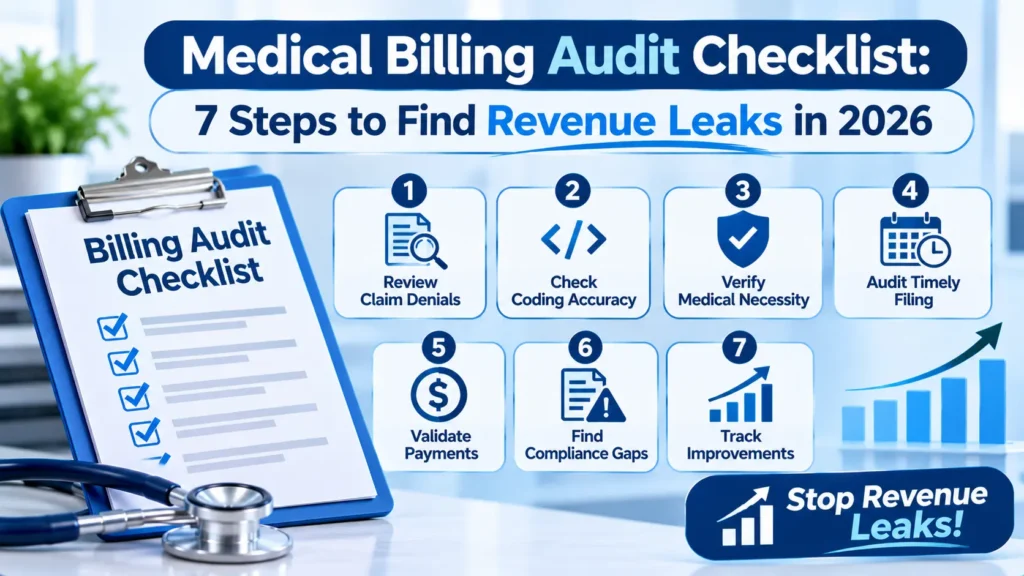
A medical billing audit checklist gives you seven repeatable checks that follow a claim from registration to final payment: scope and sample, front end, documentation and coding, claim submission, payments, denials and A/R, and compliance. Run all seven on a random sample of recent claims, score every error, and fix the root cause. That process finds the underpayments, denials, and coding gaps that quietly drain your practice.
Federal reviewers already run this exercise on you. CMS put the fiscal year 2025 Medicare fee for service improper payment rate at 6.55 percent, or $28.83 billion, and 77.17 percent of Medicaid improper payments came from insufficient documentation, according to the CMS fiscal year 2025 improper payments fact sheet. Those figures measure government payments, not your practice. They do show where reviewers look first: the record behind the claim. You can look there first, on your own schedule.
If your practice bills more than 500 claims a month, this checklist applies to you. Print it, hand it to whoever owns your billing, and set a date.
What is a medical billing audit checklist?
A medical billing audit checklist is a written list of tests you apply to a sample of claims to confirm that you billed each claim correctly, backed it with documentation, and collected the contracted rate. It turns a vague worry about lost revenue into a scored result with owners and due dates.
The checklist matters more than the audit itself. Without one, every reviewer chases a different problem. One person digs into coding, another watches denials, and nobody compares month to month. A fixed list keeps each audit comparable to the last. AAPC also draws a useful line: a medical billing audit covers the whole revenue cycle, from insurance verification and copay collection through claim submission and payment posting, while a coding audit tests code selection alone.
How often should you run a medical billing audit?
We recommend one full audit a year and a smaller targeted audit every quarter. Add monthly audits when you bill high volume, add providers, switch EHRs, or see denials spike. OIG guidance starts practices with a baseline audit, then moves to ongoing monitoring of the risk areas that baseline exposes.
Keep the schedule quiet. Don’t announce the audit period to the staff whose work you’re testing, and don’t let them pick the claims. The CMS self audit fact sheet says the people who deliver or administer the sampled items should not select them.
What are the 7 steps of a medical billing audit?
Work the steps in order. Each one feeds the next, because an error at registration shows up as a denial three weeks later.
Step 1: Set your scope and pull a random sample
Pick a lookback period, name the payers and providers in scope, and pull claims at random. Random selection lets you project your error rate across everything you billed, and it stops anyone from steering the audit toward claims that look good.
- Cover at least three months of paid and denied claims for your baseline, which matches the OIG guidance for physician practices.
- Pull at least five claims per federal payer, five to ten per provider, and at least five per service type. The CMS fact sheet suggests those ranges and says a small start beats no start.
- Ask someone outside billing to select the sample.
- Keep every provider away from the review of their own records.
- Log the claim number, date of service, payer, and billed codes in your tracker. Leave patient names out.
Picture an internal medicine practice in Tampa with four providers and 600 claims a month. Ten claims per provider, plus 20 more from each of the top two commercial payers, gives you an 80 claim baseline. To project errors across the full population, multiply the errors you found by the claims in the population, then divide by the claims you sampled.
Step 2: Audit the front end
A bad insurance ID or a missing authorization sinks a claim no matter how clean the coding looks. Test registration, eligibility, and prior authorization first.
- Match the name, date of birth, and member ID on the claim to the insurance card on file.
- Confirm someone verified eligibility before the visit and saved the payer’s response.
- Check that every service needing prior authorization had one, and that the authorization number sits on the claim.
- Review coordination of benefits when a patient carries two plans.
Our health insurance verification services exist because this step fails quietly. Read our guide to prior authorization in medical billing for the 2026 CMS rules before you test authorization timelines.
Step 3: Audit documentation and coding
Compare each claim to the visit note. The note must support every code, modifier, and diagnosis you billed, or the payer can deny the claim or recoup the payment later.
- Confirm the note carries the date of service, the provider’s signature, and credentials.
- Check that each ICD-10 diagnosis supports medical necessity for the procedure billed.
- Test the E/M level against the note. Does a 99214 meet its medical decision making or time requirement?
- Verify modifiers. Modifier 25 on a same day visit needs a separately identifiable service in the documentation.
- Confirm incident to services meet the supervision and billing rules. Habit doesn’t count. Our incident to billing guide walks through the 100 percent versus 85 percent payment question.
- Compare each provider’s code mix against peers in the same specialty and flag outliers.
Specialty matters here. An internist’s coding patterns differ from a cardiologist’s, so use our internal medicine CPT code guide as a model for how a specialty checklist reads. If you lack a certified coder, our medical billing and coding services team can run this step for you.
Step 4: Audit claim submission and charge capture
A claim can be correct and still leak money. Check that every billable service reached a claim, that the claim left on time, and that it passed the payer’s edits on the first try.
- Match the schedule and visit notes to posted charges to catch services nobody billed.
- Measure charge lag, the days between the visit and the claim.
- Check your first pass clean claim rate and list every clearinghouse rejection reason.
- Verify timely filing. Medicare gives you one calendar year from the date of service, while commercial contracts often give far less, so pull each contract.
- Confirm CMS-1500 fields match payer rules, including rendering and billing NPI and place of service.
Fix the Denials Your Audit Finds
Denials that trace back to the front end or to coding keep returning until someone owns the root cause. Our Denial Management Services team tracks CO-97, CO-50, and PR-96 patterns by payer and fixes the workflow behind them to reduce claim denials. If your sample shows repeat denials, ask us to review the pattern with you.
Step 5: Audit payments for underpayments
Compare what each payer paid to what your contract says it should pay. Underpayments hide inside approved claims, so no denial fires and nobody follows up.
Here’s our opinion, and we’ll defend it: most practice managers overrate coding audits and underrate payment audits. A coding error shows up in one visit. A fee schedule loaded wrong repeats on every claim from that payer.
- Load the contracted rate for your highest volume CPT codes into a sheet, one tab per payer.
- Compare the allowed amount on each ERA to that rate, line by line.
- Check adjustment group codes. CO marks a contractual obligation. PR marks patient responsibility.
- Match patient balances to the EOB before you send a statement.
- Test posting. Payments should land on the right claim, date, and service line.
Illustrative math, not a client result: if one payer underpays 100 of your 500 monthly claims by $15 each, you lose $1,500 a month, or $18,000 a year, and no denial ever warns you.
Step 6: Audit denials and A/R
Sort every denial by root cause, not by the payer’s note. You’re hunting for the five or six fixable causes behind most of your rework.
- Group denials by reason code: CO-97 (bundled into another service), CO-50 (medical necessity), PR-96 (non covered charge), CO-29 (timely filing), and CO-16 (missing information).
- Check that staff appealed inside each payer’s deadline, and record your win rate.
- Age your A/R in buckets: 0 to 30, 31 to 60, 61 to 90, and over 90 days.
- Confirm a named person owns every claim older than 60 days.
Our revenue cycle management services team builds this denial and A/R review into a monthly routine, which beats a once a year scramble.
Step 7: Close the loop on compliance and overpayments
Audit results only matter when you act on them. Document the findings, correct the claims, return money you owe, and assign an owner to every fix.
Overpayments carry a deadline. Under the CMS overpayment rule that took effect January 1, 2025, you have identified an overpayment when you knowingly receive or retain it, and you generally have 60 days to report and return it. If you start a timely, good faith investigation into related overpayments, the 60 day clock can pause for up to 180 days. We’re a billing company, not your lawyer, so bring compliance counsel in before you decide how to handle a refund.
- Write a one page summary covering method, sample, findings, and dollars. CMS says the record should convince an interested but uninformed third party that your process was reasonable.
- Correct and resubmit claims inside filing limits.
- Return overpayments inside the 60 day window and keep proof.
- Train staff on every error pattern you found, then retest in 90 days.
- Screen staff and vendors against the OIG exclusions database.
Which numbers tell you a revenue leak exists?
These are our working audit triggers, not industry mandates. Set your own after your baseline. We run a 96 percent clean claim rate across our clients, so a result under 95 percent tells us something broke.
What does a medical billing audit tracker look like?
Build one row per claim and one column per test. Mark each test 1 for an error and 0 for a pass. CMS advises testing one thing per question, so avoid compound wording with and, or, or but.
Keep the audit file HIPAA compliant. Use claim numbers instead of names, share only the minimum necessary detail, and store the worksheet where you already protect PHI, with the same access controls.
How do you run a self audit in a physician practice?
Spread the seven steps across four weeks and keep each session under two hours. A small practice with one biller can run this without new software.
- Week one: Steps 1 and 2. Pull the sample and test registration, eligibility, and authorization.
- Week two: Steps 3 and 4. Compare notes to codes, then check charges and filing.
- Week three: Steps 5 and 6. Test payments, denials, and A/R aging.
- Week four: Step 7. Write the summary, assign fixes, and book the retest.
Your biller shouldn’t audit alone. CMS suggests pairing the person in charge of billing with a medically trained reviewer, ideally a physician, for claim reviews. If you can’t staff that, borrow a reviewer from outside the practice for Step 3.
What should your audit check before January 1, 2027?
CMS finalized the CY 2027 physician fee schedule on November 4, 2026, and several changes hit payment on January 1. The AMA’s final rule summary lists them. Add these to Steps 3 and 5.
- Conversion factor: $32.6286 for non APM practitioners, a 2.31 percent decrease from 2026, and $32.9548 for APM QPs, a 1.83 percent decrease. The temporary 2.5 percent increase expires.
- Modifier 25: payment for other same day services drops 20 percent when you bill a separately identifiable office E/M with modifier 25 alongside a 0 day global procedure, within the same specialty and group.
- G2211 goes away. Modifier B1 replaces it at 16 percent of the base E/M code.
- Telehealth flexibilities run through 2027.
- Remote monitoring needs an initiating visit, and RTM applies to established patients only.
Reload every fee schedule in January, then rerun Step 5 on your first 30 paid claims.
Billing audit vs coding audit vs compliance audit: which do you need?
Most practices need all three over a year, but they answer different questions.
Should you run a billing audit in house or outsource it?
Run it in house if you have a trained reviewer who doesn’t touch billing every day. Outsource it if your billing lead audits their own work, you lack a certified coder, or the sample takes more than a few days.
Our CPC certified billers run audits against the same seven steps in this article. We start with a free billing audit of your last 90 days of claims, so you see findings before you spend anything.
What should you do this week?
Pull 30 recent claims, then run Steps 2 and 5 first. They find money fastest. Finish the other five steps over the next month, and book your retest before you close the file.
Get a Free Billing Audit
Your audit shows where claims leak. Fixing those leaks month after month takes billing, coding, and follow up working together. Our Medical Billing Services team runs a free billing audit on your last 90 days of claims, with no setup fee. Get medical billing support to see where your revenue is slipping.
Frequently asked questions about medical billing audits
How often should a medical practice run a billing audit?
Run a full audit once a year and a targeted audit each quarter. Move to monthly audits after a new EHR, new providers, or a denial spike. Start with a baseline audit, then monitor the areas it flags.
What is the difference between a coding audit and a billing audit?
A coding audit tests whether the codes and modifiers match the documentation. A billing audit covers the whole cycle, including insurance verification, charge capture, claim submission, payment posting, and follow up.
How much revenue can a practice recover from audit findings?
No single sourced figure fits every practice, and vendor claims vary widely. Estimate yours from a random sample: multiply errors found by claims in the population, divide by claims sampled, then multiply by your average payment. CMS’s 6.55 percent Medicare improper payment rate measures government payments, not your recoverable revenue.
What are the most common revenue leaks audits surface?
Eligibility errors, missing prior authorizations, notes that don’t support the code billed, modifier mistakes, services never charged, payer underpayments, missed timely filing windows, and denials nobody works.
Should we run audits internally or outsource them?
Run them in house when you have a trained reviewer who doesn’t handle daily billing. Outsource when your biller audits their own work, you lack a certified coder, or sampling takes too long.
How many claims should I sample for a self audit?
The CMS self audit fact sheet suggests at least five claims per federal payer, five to ten per provider, or at least five per service type. Higher risk areas call for larger samples, and starting small still beats not starting.
Who should perform a self audit?
Pair the person in charge of billing with a medically trained reviewer. Providers shouldn’t review their own records, and the people who produced the claims shouldn’t select the sample.
What should I do if the audit finds an overpayment?
Report and return it, generally within 60 days of identification under the CMS rule effective January 1, 2025. A timely, good faith investigation into related overpayments can pause that clock for up to 180 days. Ask compliance counsel to guide the refund.
Which denial codes should I track in an audit?
Start with CO-97 (bundled service), CO-50 (medical necessity), PR-96 (non covered charge), CO-29 (timely filing), and CO-16 (missing information). Track them by payer and provider to find patterns.
How do I keep audit records HIPAA compliant?
Use claim numbers instead of patient names, limit access to staff who need it, share the minimum necessary detail, and store the audit file with your other PHI under the same safeguards.
Published November 23, 2026. This article covers billing and compliance practices, not legal or medical advice.