
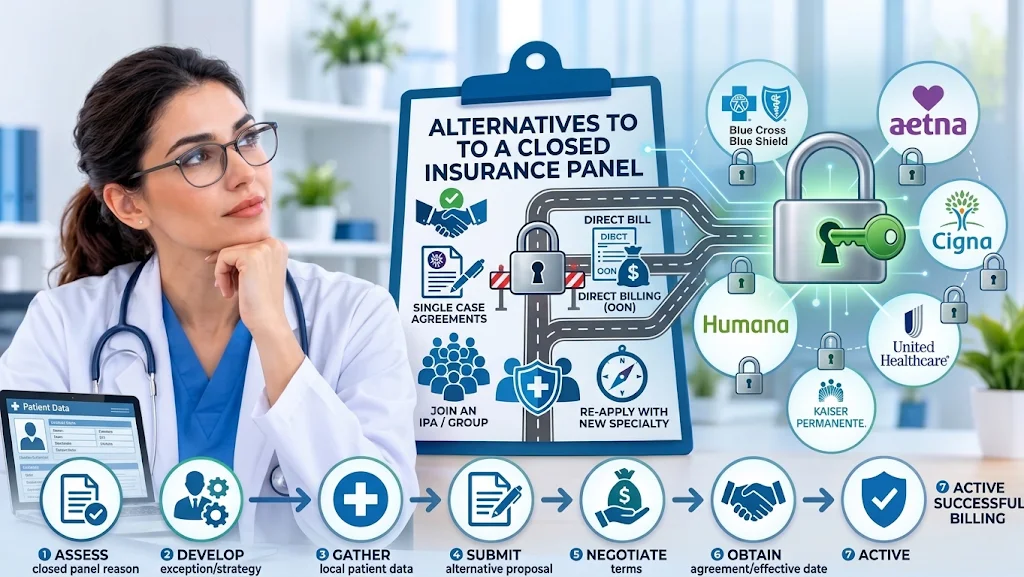
A closed insurance panel doesn’t close your practice. You have seven realistic alternatives: request a panel exception, negotiate single case agreements, bill out of network while credentialing is pending, work under a group contract that already holds the panel spot, offer a cash pay option with superbills, target the payer’s network adequacy gaps, and reapply on the payer’s review cycle. This guide covers how each one works, what it pays, and the billing mistakes that cost practices money while they wait.
Here’s the scene we see most often. A family medicine nurse practitioner opens a practice in Tampa, finishes her CAQH profile, applies to five commercial payers, and gets three letters back that read almost word for word the same: the network is adequate in your county and we’re not accepting new providers of your type at this time. Meanwhile 40 percent of the patients calling the front desk carry one of those three plans. If that sounds like your month, this applies to you.
Why do insurance panels close to new providers?
Payers close panels when they decide they already have enough contracted providers of your specialty in your service area. The decision rests on network adequacy math, not on your qualifications.
Each payer measures provider to member ratios and drive time standards by county. Medicare Advantage plans answer to CMS adequacy standards. Commercial plans answer to state insurance departments and, for many, to NCQA accreditation rules. Once the plan hits its number for a specialty in a county, the contracting team stops issuing new agreements. A panel can be closed for behavioral health in Hillsborough County and wide open two counties north.
Closed also rarely means permanent. Providers retire, move, or drop the plan. Membership grows after open enrollment. Most payers revisit panel status quarterly, and some do it twice a year. Behavioral health, physical therapy, chiropractic, and primary care in metro areas close most often, which is exactly why those specialties need a plan B before the first application goes out.
What should you do first when a payer says the panel is closed?
Ask the payer in writing why the panel is closed, when the network team reviews it next, and what the exception process looks like. Then build a case around the gap you fill.
- Get the closure in writing with a date and a contact in network management. A verbal “we’re closed” from a call center rep isn’t a decision you can appeal.
- Request the exception form. Most large payers (UnitedHealthcare, Aetna, Cigna, and the BCBS plans) run a network need or exception process even when the first rep says no such thing exists.
- Document the gap you fill. Languages spoken, evening or weekend hours, telehealth across the state, subspecialty training, a ZIP code where members drive over 30 minutes for care, or a six week wait list at the nearest in network provider. Attach proof, not adjectives.
- Get patients involved. Members who call their plan and ask for you by name create a record the network team sees. Three calls from members in one month carry more weight than one letter from you.
- Calendar the reapply date. Submit again the week the review window opens, not three months later when someone remembers.
Most practice managers give up after the first letter. The ones who get onto closed panels treat the closure like a prior authorization denial: they appeal it, with evidence, on the payer’s timeline. Our insurance credentialing services team handles the exception paperwork and the follow up calls so your front desk doesn’t have to.
Can you bill out of network while waiting for credentialing?
Yes, with limits. Out of network billing while waiting for credentialing works when the patient’s plan carries out of network benefits, which means PPO and POS plans. It fails on HMO and EPO plans, which usually pay nothing out of network except for emergencies.
Medicare rewards speed
Medicare is the one payer that pays you backward. Under 42 CFR 424.521, Medicare allows physicians and nonphysician practitioners to bill retroactively for up to 30 days before the enrollment effective date, and 42 CFR 424.520 sets that effective date as the later of the filing date or the date the provider first furnished services at the location. File the CMS-855I or the PECOS application before the provider sees a single Medicare patient and you protect every date of service. File it 45 days after the start date and the first two weeks are unbillable, permanently.
Commercial payers rarely backdate
Most commercial plans set the effective date at contract approval or signature and refuse in network payment for anything earlier. A few BCBS plans will backdate when you add a provider to an existing group contract, but you need that promise in writing before you hold a single claim. During the gap you have three options for commercial patients:
- Bill out of network with the patient’s written consent, collect the out of network cost share at the visit, and accept the plan’s allowed amount.
- Hold the claims and release them after the effective date, only if the payer confirms backdating in writing.
- Treat the visit as self pay, hand the patient a good faith estimate, and give them a superbill to submit on their own.
Held claims carry a hidden risk. Timely filing limits run from 90 days to one year depending on the payer, and the clock starts on the date of service, not the credentialing date. A claim held past the limit comes back as CO-29 and you can’t appeal your way out of it. Track every held claim with its date of service and the payer’s filing deadline on one shared sheet, and release anything within 30 days of the deadline even if the effective date hasn’t arrived.
One more step people skip: verify out of network benefits before the visit, not after. A real time check through our insurance eligibility verification services tells you whether the patient has an out of network deductible of 500 dollars or 6,000 dollars, which changes the conversation at check in completely.
What is a single case agreement and how do you get one?
A single case agreement (SCA) is a one time contract between a payer and an out of network provider that covers one specific patient for a defined period at a negotiated rate, often at the patient’s in network benefit level. It’s the closest thing to being on the panel without being on the panel.
Payers approve SCAs in four situations:
- No in network provider within the plan’s distance or wait time standards.
- No in network provider with the subspecialty, language, or treatment modality the patient needs.
- Continuity of care for an established patient who changed plans, or whose provider left the network mid treatment.
- The plan has no out of network benefit at all, but the provider documents medical necessity and the patient requests the exception.
Here’s the sequence that gets SCAs approved instead of lost in a queue. Call provider services and ask for the single case agreement or network exception department by name. Submit the patient name, member ID, diagnosis codes, the CPT codes you expect to bill, the number of visits, your requested rate, NPI, tax ID, and a W-9. Propose the rate yourself and anchor it to your full fee or a stated percentage of the Medicare fee schedule. Payers that set the first number set it low. Get the agreement number and the covered date range in writing before the first visit, bill exactly as the agreement instructs, and set a reminder 30 days before expiration to request an extension.
Expect two to four weeks for a decision, sometimes the full 30 days. Medicaid managed care plans use SCAs routinely when their network lacks a specialty, and some will approve them faster than commercial plans. The limit is scale. One agreement covers one patient, so SCAs keep a referral relationship alive during a 120 day credentialing wait. They don’t replace a contract.
Stop Losing Revenue to Closed Panels
Credentialing delays and closed panels leave revenue unbilled for months, and every week of waiting without a plan costs real visits. Our insurance credentialing services cover panel status checks before you apply, exception requests, CAQH upkeep, and payer follow up every two weeks until you hold an effective date. Talk with our credentialing team about the payers you’re waiting on.
Should you join a group practice to get on insurance panels?
Joining a group can get you paid under a closed panel because the contract belongs to the group’s tax ID, and payers often add providers to an existing group agreement even after they’ve stopped issuing new individual contracts. The panel is closed to new contracts, not always to new rendering providers on old ones.
Three routes exist, and they differ a lot in what you give up:
- Employment or an independent contractor agreement with an established group. You reassign benefits to the group, claims go out under the group NPI with you listed as the rendering provider, and the group pays you a salary or a split.
- Delegated credentialing. Large groups, IPAs, and health systems hold delegation agreements where the payer accepts the group’s own credentialing committee decision. Providers get loaded in 30 to 45 days instead of 90 to 180.
- An IPA or MSO membership. You keep your own tax ID and practice, and you access the organization’s payer contracts in exchange for a membership or management fee.
The tradeoff is ownership. The panel spot belongs to the group, so if you leave, you start the application cycle over, and the payer may still be closed. Read the agreement for the fee split, who collects receivables after you leave, any noncompete radius, and who owns the patient list. We’ve watched practices join a group for one payer’s contract and hand 35 percent of collections to a management fee. Run the numbers on that specific payer’s patient volume before you sign anything.
Cash pay vs out of network superbill: which keeps more revenue?
Cash pay collects 100 percent of your fee at the visit and shifts all insurance work to the patient. The superbill route collects the same fee up front and adds a document the patient uses to claim their own out of network reimbursement. Most practices should offer both at once, because the superbill costs you almost nothing extra and it keeps PPO patients from leaving.
The good faith estimate isn’t optional. Under the No Surprises Act, every uninsured or self pay patient who schedules three or more business days ahead receives a written estimate of expected charges, and a patient billed 400 dollars or more above that estimate can open the federal patient provider dispute process. A patient who has insurance but asks you not to bill it counts as self pay under the rule. Build the estimate into your scheduling workflow rather than your memory.
A superbill that actually gets reimbursed includes the rendering provider’s name, NPI, and tax ID, the practice address, the patient’s name and date of birth, each date of service with CPT codes and modifiers, ICD-10 codes linked to each line, the charge and the amount paid per line, and the place of service code. Leave off the diagnosis pointer and the plan rejects it, then the patient calls you. Our patient statement services produce superbills and compliant estimates as part of the normal statement cycle, so the front desk isn’t typing them by hand.
How do provider enrollment delays turn into lost revenue?
Provider enrollment delays cost a practice money three ways: visits you can’t bill in network, held claims that die to timely filing, and patients who move to an in network competitor while they wait.
Consider an illustrative provider who sees 18 patients a day, four days a week, at an average allowed amount of 140 dollars. That’s about 10,000 dollars a week in billable allowed charges. A 90 day credentialing wait with half of those patients on closed or pending plans puts roughly 65,000 dollars at risk. Recover 40 percent of it through out of network claims and single case agreements and you still have 39,000 dollars that never gets billed. That’s one provider, one quarter.
The delays themselves come from a short list of causes:
- A lapsed CAQH attestation or a missing document (malpractice face sheet, DEA certificate, board certification) that stalls the file for weeks before anyone notices.
- A mismatch between the application and the IRS or NPPES record: wrong practice address, old tax ID, or a legal name that doesn’t match the W-9.
- Payer backlog. Ninety to 180 days is common for commercial plans, and state Medicaid programs range from 30 days to six months.
- No follow up. Applications sit in a queue, and the ones that move are the ones someone calls about every 14 days with the reference number in hand.
Four habits cut the damage. Start credentialing 120 days before the provider’s first day. Apply to every target payer in parallel instead of one at a time. Check panel status before you apply so you don’t spend 90 days waiting on a payer that was never going to say yes. And log every call, reference number, and promised date in one tracker that someone reviews weekly.
What should your first 90 days look like when a panel is closed?
A closed panel plan runs on a calendar, not on hope. Here’s the sequence we use with new providers.
Practices that already handle billing for several specialties, such as medical billing for small practices, tend to recover faster here because the self pay and out of network workflows already exist. A solo practice building them from scratch during a closed panel wait feels every week of it.
Keep Revenue Moving While You Wait
If closed panels have pushed your practice into a mix of out of network claims, single case agreements, held claims, and self pay visits, the billing gets messy fast and revenue leaks at every handoff. Our medical billing services track every held claim against its filing deadline, bill SCAs exactly as the agreement requires, and produce compliant superbills and good faith estimates. Book a free billing audit and a dedicated specialist will review your last 90 days of claims.
Frequently asked questions about closed insurance panels
What does it mean when an insurance panel is closed?
A closed panel means the payer has stopped accepting new provider contracts for your specialty in your service area because it considers its network adequate. It isn’t a rejection of your credentials. Panels reopen when providers leave, membership grows, or a state or CMS adequacy review finds a gap, and most payers reassess them every three to six months.
How long do insurance panels stay closed?
There’s no fixed term. Payers typically review panel status quarterly, though some review twice a year and a few hold panels closed for years in saturated metro areas. Ask the network team for the next review date in writing and reapply the week that window opens.
Can I see patients before credentialing is complete?
Yes, but how you get paid depends on the payer. Medicare allows retroactive billing for up to 30 days before your enrollment effective date. Most commercial payers pay nothing in network before the effective date, so you bill out of network where the plan allows it, request a single case agreement, or treat the visit as self pay with a good faith estimate.
Does a single case agreement pay in network rates?
Often, but not automatically. A single case agreement sets a negotiated rate for one patient and usually applies the patient’s in network cost sharing. The rate itself is whatever you and the payer agree to, so propose your number first and anchor it to your full fee or a percentage of the Medicare fee schedule.
Can I bill a patient directly if their plan’s panel is closed to me?
Yes, if the patient agrees to self pay or the plan has out of network benefits. You must give a written good faith estimate under the No Surprises Act when the patient schedules three or more business days ahead, and you should collect a signed acknowledgment that you’re out of network for their plan. Check your state’s balance billing rules for any extra notice requirements.
Is joining a group practice the fastest way onto a closed panel?
It’s usually the fastest route to in network payment, since payers often add rendering providers to an existing group contract even when they’ve stopped issuing new individual ones, and delegated credentialing can load you in 30 to 45 days. The cost is independence: the contract belongs to the group, and you’ll pay a split or management fee.
What happens if I bill a payer before my effective date?
The claim denies, typically with a provider not eligible or not enrolled reason code, and the payer won’t reprocess it once your effective date posts unless they agreed to backdate in writing. If you’ve already submitted claims, correct them to out of network status where the plan allows, or convert the visits to self pay and refund any patient overpayment.