
Emergency Medicine Billing Services That Protect Revenue When Every Minute Counts
Emergency medicine billing services cover the coding, claim submission, denial management, and accounts receivable follow-up for every ED encounter, procedure, and critical care minute your group bills. Scheduled specialties start with a confirmed appointment and verified insurance. Emergency medicine starts with neither. A patient arrives, gets treated, and only then does anyone confirm who’s paying. That gap is a big reason emergency departments deny claims at a rate well above the average medical practice. Medicotech built its emergency medicine billing services around that reality: fast, defensible coding, proactive eligibility work, and denial prevention instead of denial cleanup.
What Changed in the 2026 E/M Rule for Emergency Department Coding?
Emergency department E/M codes, 99281 through 99285, select purely on medical decision making under current CMS and AMA guidance. Office visits and several other settings can use total time as an alternative. The emergency department can’t. That single difference means a physician who under-documents medical decision making has no time-based fallback the way an internist does.
Critical care time (99291 for the first 30 to 74 minutes, 99292 for each additional 30 minutes) stays time based, and it remains one of the most underbilled categories in emergency medicine. Coders who only read the discharge diagnosis routinely miss physician time spent stabilizing a patient earlier in the chart.
Split and shared visits, common where physicians and advanced practice providers cover the same ED together, now hinge on who performed the substantive portion of the encounter: more than half the combined time, or a substantive part of the medical decision making. CMS dropped the separate FS modifier requirement, but the documentation still has to identify each clinician’s contribution clearly enough to support whoever bills the visit. Get that wrong and you’re not just looking at a denial. You’re looking at a compliance exposure. Our Medical Coding Services can help ensure emergency department documentation and E/M coding are reviewed accurately before claims are submitted.





Why Do Emergency Departments Deny Claims at a Higher Rate Than Other Specialties?
Across all physician specialties, MGMA’s practice benchmarking puts the median claim denial rate at 11.1 percent, with top-performing practices holding it under 4 percent. Emergency medicine runs well above that median. State-level claims data presented to the Maryland General Assembly in 2026 found that more than 1 in 7 emergency department claims gets denied, and ED denials make up nearly 40 percent of every denied claim in the healthcare system.
Five things drive most of it, and none of them are the biller’s fault alone.
Registration Under Pressure
Insurance data gets typed in fast during emergency intake, often mid-triage before the patient can confirm details. Small errors compound into eligibility denials weeks later. Review our RCM solutions to prevent front-end mistakes.
Treatment vs. Billing Documentation
Physicians prioritize patient stabilization over building a chart to justify specific E/M levels, leaving vital medical decision making under-captured. Discover how our medical billing services capture accurate clinical data.
Payer Reclassifications
A growing number of plans review emergency claims retroactively, downgrading visits they decide were nonemergent even when symptoms warranted an emergency workup. Learn more about handling payer pushback on our blog.
Professional & Facility Split Billing
Encounters produce dual claims covering different clinicians and independent billing systems, requiring rigorous alignment to prevent leakage. Contact our team to streamline your split-claim workflows.
Emergency E/M Selection (CPT 99281–99285)
Emergency department E/M levels now select purely on medical decision making. Time is no longer an option the way it is for office visits, meaning undocumented decision making results directly in a lower-paid level or an outright denial. Explore our comprehensive services overview to ensure compliance with updated 2026 standards.
A denied ED claim doesn't just delay payment. Medicotech's emergency medicine billing services include a denial specialist who works ED-specific denial reasons daily, from MDM downcoding to retroactive nonemergent reclassification.
How Does the No Surprises Act Affect Emergency Medicine Billing?
Emergency medicine sits at the center of the No Surprises Act in a way almost no other specialty does. The law bans balance billing patients for out-of-network emergency care, treats the visit as in-network for the patient’s cost sharing, and pushes the actual payment dispute between your group and the insurer into a federal independent dispute resolution (IDR) process when negotiation fails.
That process changed recently. A June 2026 final rule from the Departments of Labor, HHS, and Treasury, effective August 3, 2026, tightened how insurers, providers, and certified IDR entities communicate during a dispute. The American College of Emergency Physicians has reported that the update also cut IDR arbitration fees by more than 85 percent, from 115 dollars down to 15 dollars, which matters if your group has been sitting on disputes too small to justify the old fee.
The financial stakes aren’t small. A 2025 RAND Corporation analysis found that in-network commercial reimbursement for ED physician services fell 10.9 percent between 2018 and 2022, while out-of-network reimbursement dropped nearly 48 percent over the same period. Separately, ACEP has cited RAND figures showing 20 percent of emergency physician payments go unpaid across all payer types, a combined 5.9 billion dollars a year. A billing partner that doesn’t actively track IDR eligibility and payer negotiation deadlines leaves part of that money on the table by default.
For practices looking to strengthen the broader claims and reimbursement process, our Revenue Cycle Management Services can also support payment tracking, denial management, and A/R follow-up.
What Does Medicotech's Emergency Medicine Billing Service Include?
Medicotech's emergency medicine billing services cover the full revenue cycle, not just claim submission. We serve emergency medicine groups across all 50 states, from single-site EDs to multi-facility coverage models.
Coding Built for ED Complexity
Certified coders trained on MDM-only E/M leveling, critical care time, ambulance and EMS coordination where applicable, and split-shared documentation, so codes hold up under payer review.
- Backed by expert medical coding services.
- Optimized for 2026 MDM emergency standards.
Post-Treatment Insurance Verification
You can't check eligibility before an emergency visit. We verify coverage, plan type, and patient responsibility during or immediately after treatment instead, before the claim goes out.
- Seamless health insurance verification services.
- Accurate typing validation post-triage.
Targeted Denial Management
MDM downcoding, retroactive nonemergent reclassification, and split-billing conflicts get worked by someone who has seen the pattern before.
- Advanced denial management services.
- Proactive defense against retroactive plan downgrades.
Complete Cycle & Enrollment Support
Tracks encounters from charge capture through final payment, including No Surprises Act compliance, plus rapid provider credentialing and patient help desks.
- Comprehensive revenue cycle management.
- Streamlined insurance credentialing services.
Which EHR and Hospital Systems Does Medicotech Support?
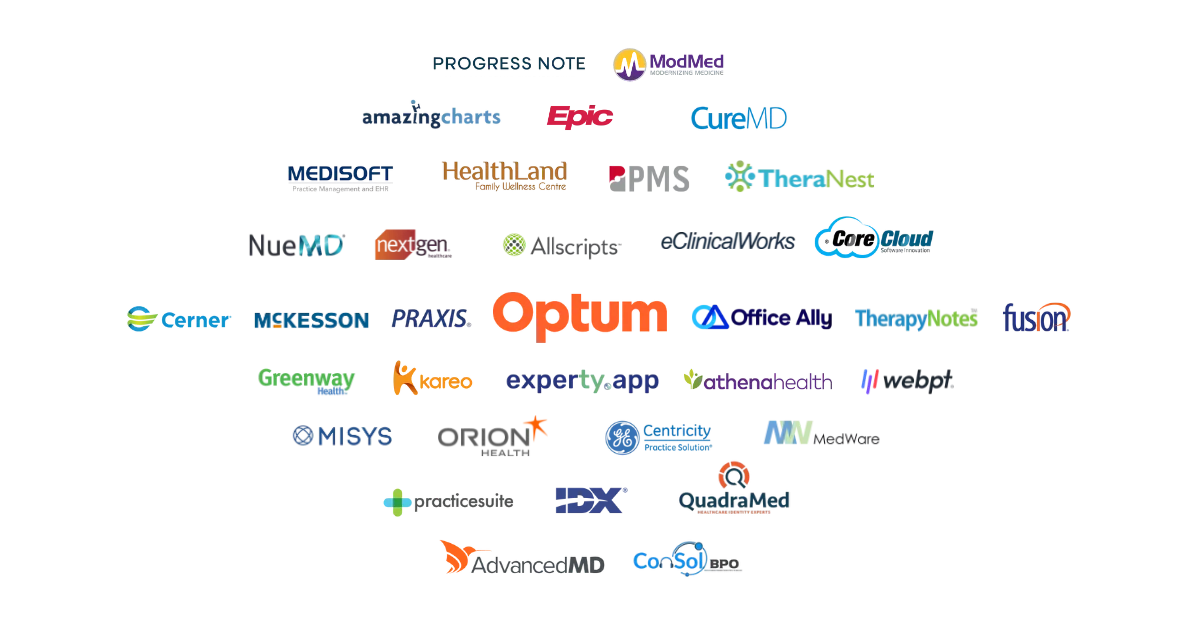
Emergency departments rarely control their own EHR choice. You’re usually working inside whatever the hospital or health system runs, and your billing partner needs to fit that, not the other way around. Medicotech integrates with Epic, Cerner, Meditech, athenahealth, eClinicalWorks, NextGen, and the other major hospital and ambulatory systems ED groups run on. No forced migration, no disruption to how your clinical team already documents. For practices looking to improve the entire reimbursement workflow, our Medical Billing Services can work alongside your existing systems without requiring changes to your clinical documentation process.
Transparent Billing Models & The True Cost of Denials
Understand how performance-based collection models protect your budget and why proactive denial management safeguards emergency revenue.
How Does Medicotech Charge for Emergency Medicine Billing?
Medicotech charges a percentage of collections, typically 4 to 8 percent depending on encounter volume and specialty mix. There's no setup fee and no long-term contract locking you in.
- Free Initial Audit: Covers coding accuracy, eligibility workflow, and current A/R.
- Risk-Free Evaluation: See the gap before you sign anything.
What Does a High Denial Rate Cost an Emergency Department?
Run the math and the abstract problem turns into a real number fast. MGMA's benchmarking puts the median denial rate across physician practices at 11.1 percent.
- Speed Matters: A claim reworked on day 15 has a solid shot; day 60 fights a timely-filing clock.
- Recoverable Revenue: Catching patterns early prevents permanent write-offs.
What Emergency Medicine Providers Say About Medicotech
Real accounts from physicians and clinical leaders who streamlined their emergency medical billing and maximized collections.
After three billing companies that didn't work out, Medicotech finally fixed our ambulance transport coding. Collections jumped 22 percent in Q1 once they got our EMS modifiers right. Worth every dollar.
When insurance pushes back, their team fights back harder. It feels like having a pit crew for billing headaches.
They audit our charts like a pit crew audits a car. They found 14,000 dollars in missed facility fees from trauma activations last month alone. Finally, a team that gets that emergency medicine isn't a nine-to-five job.
Emergency medicine billing rewards speed and precision, and neither happens by accident.
Frequently Asked Questions
What are emergency medicine billing services?
Emergency medicine billing services handle coding, claim submission, denial management, and accounts receivable follow-up for ED encounters, procedures, and critical care time. Because emergency patients arrive without a scheduled appointment or verified insurance, this billing requires post-treatment eligibility work, MDM-only E/M coding, and coordination between professional and facility claims that scheduled specialties don’t need.
Why do emergency departments have higher denial rates than other specialties?
Emergency departments deny claims at a rate above the 11.1 percent median MGMA tracks across physician practices, with state-level data showing more than 1 in 7 ED claims denied. Rushed registration, documentation built for treatment rather than billing, and payers retroactively reclassifying visits as nonemergent are the three biggest drivers.
How did the 2026 E/M coding update change emergency department billing?
Emergency department E/M codes 99281 through 99285 now select purely on medical decision making, with no time-based option the way office visits have. A physician’s documentation has to fully support the decision-making complexity of the visit, since there’s no total-time fallback if it falls short.
What is a split or shared visit, and how does it get billed in emergency medicine?
A split or shared visit happens when a physician and a nonphysician practitioner both treat the same ED patient. Current CMS policy pays the clinician who performed the substantive portion, meaning more than half the combined time or a substantive part of the medical decision making, and documentation must clearly show each clinician’s contribution.
How does the No Surprises Act affect emergency medicine billing?
The No Surprises Act bans balance billing patients for out-of-network emergency care and routes payment disputes into a federal independent dispute resolution process. A June 2026 final rule, effective August 2026, changed how that process runs and reportedly cut IDR arbitration fees by more than 85 percent.
What is critical care billing, and how is it different from a standard ED visit?
Critical care billing uses CPT 99291 for the first 30 to 74 minutes of physician time and 99292 for each additional 30 minutes, and it stays time based even though standard ED E/M codes no longer are. It’s also one of the most consistently underbilled categories, since coders who only read the final note miss time documented earlier in the chart.
Does an emergency medicine billing company handle provider credentialing?
Yes. Medicotech’s emergency medicine billing services include provider credentialing and payer enrollment, so ED physicians and advanced practice providers get privileged and enrolled without delaying their start date. Credentialing runs alongside billing setup rather than as a separate, disconnected process.
How much does outsourced emergency medicine billing cost?
Medicotech charges a percentage of collections, typically 4 to 8 percent depending on encounter volume and specialty mix, with no setup fee and no long-term contract. Because payment is tied to what you actually collect, the incentive to chase denials and follow up on aging claims stays aligned with yours.
How long does it take to switch to a new emergency medicine billing service?
Most emergency medicine groups can transition within 30 to 60 days, depending on payer enrollment timelines and how much historical A/R needs to transfer. Medicotech starts with a free billing audit before onboarding, so you know what’s moving and what needs cleanup before go-live.
Which EHR systems does Medicotech support for emergency medicine billing?
Medicotech integrates with Epic, Cerner, Meditech, athenahealth, eClinicalWorks, NextGen, and the other major hospital and ambulatory EHR platforms emergency groups run on. Since EDs rarely choose their own EHR, our billing workflow adapts to whatever system your hospital or health system already has in place.
How does outsourcing emergency medicine billing improve revenue?
Outsourcing to a specialty-trained team reduces the denials tied to ED-specific coding rules, speeds up eligibility work that has to happen after treatment instead of before it, and puts dedicated follow-up behind aging claims. At the MGMA median 11.1 percent denial rate, even modest improvement translates into thousands of dollars a month for a mid-volume ED.
What makes Medicotech different from other emergency medicine billing services providers?
Medicotech pairs CPC and CPB certified billers with coding workflows built specifically around MDM-only E/M leveling, critical care time, and split-shared documentation, instead of general medical billing rules stretched to fit the ED. Medicotech LLC is based in St. Petersburg, Florida, and serves emergency medicine groups in all 50 states.