
Urgent Care Billing Services That Cut Denials and Keep Pace With Walk In Volume
Urgent care billing services handle every financial step between a walk in patient and a paid claim: eligibility checks at the front desk, coding for the visit and any same day procedures, claim submission, payment posting, denial work, and patient balances. Medicotech runs that full cycle for independent and hospital affiliated urgent care centers in all 50 states. Our CPC certified billers and CCS certified coders know S9083, POS 20, and modifier 25 rules cold.
| Problem | Why it happens | What it costs you | What we do |
|---|---|---|---|
| Wrong billing model for the payer | Some commercial plans and Medicaid programs pay the S9083 global fee, others want itemized E/M plus procedures, and Medicare doesn't pay S codes at all | Flat denials, or a global fee that underpays a visit with a repair and imaging | We build a payer routing table from your contracts and apply it at charge entry |
| Wrong place of service | EHR site setup defaults to POS 11 (office) or 22 (outpatient hospital) instead of POS 20 | Every claim from that location prices wrong until someone notices | We lock POS by site and check it on every claim batch |
| Modifier 25 without support | The note doesn't show a significant, separately identifiable E/M apart from the procedure | Bundling denials now, recoupments in a later audit | Coders confirm a distinct assessment and plan before they append the modifier |
| Point of care lab denials | Claims miss the CLIA certificate number or the QW modifier for waived tests | Rapid strep, flu, and COVID test lines deny while the visit pays | We store CLIA numbers per site and run an automatic QW check |
| Walk in eligibility gaps | Patients present old cards, changed jobs, or switched Medicaid plans | CO-27 and CO-31 denials two to three weeks after the visit | Real time eligibility at check in, plus coverage discovery on every self pay |
| Automatic downcoding | Cigna, Aetna, and other payers algorithmically cut level 4 and 5 visits for providers they flag as outliers | Lower revenue per visit on your most complex patients | Monthly E/M distribution audits by provider and documented appeals |
| Occupational medicine never invoiced | Employer physicals, drug screens, and DOT exams run outside the insurance claim path | Work gets done and nobody raises the receivable | A separate employer invoicing track with its own aging report |
Why is urgent care billing harder than regular office billing?
Picture a Saturday afternoon at an urgent care center in Tampa. A 9-year-old comes in after a fall with a 3 cm forearm cut. The provider rules out a fracture with a wrist X-ray, repairs the laceration, gives a tetanus booster, and sends the family home in 50 minutes. (This is an illustrative scenario, not a patient record.) That one visit can carry an E/M code with modifier 25, a simple repair code (12002), an imaging code (73100 or 73110), a vaccine code, and its administration code. Miss a line and your center absorbs the cost. Bill the lines wrong and the payer bundles them under CO-97. Following CO-97 Denial Code guidance can help your billing team understand bundling-related denials and avoid preventable claim errors.
Here’s our honest take. Most urgent care operators watch door-to-door time closely and barely glance at the 30 seconds at registration where someone keys in the wrong plan. In our experience, those 30 seconds feed more denials than any coding mistake.
What do our urgent care billing services include?
You get the full revenue cycle, from check in to the final posted dollar. We split the work into front end, coding, and back end tasks so nothing waits on one overworked person.
- Real-time eligibility and benefits checks for every walk-in, with the copay, deductible, and coinsurance your staff should collect at the counter
- Coverage discovery for patients who arrive without a card or with an outdated one
- Good faith estimates for uninsured and self-pay patients who ask for one
- Workers' comp and employer account setup before the provider sees the patient
Our team can verify coverage before the provider walks in, which matters more in urgent care than anywhere else. You don't get a scheduling window. The patient walks in, and the eligibility check has to happen in minutes.
- E/M leveling for 99202 to 99215 based on medical decision making or total time on the date of service
- Procedure capture for laceration repair, incision and drainage, splinting, foreign body removal, and in-clinic imaging
- Modifier 25, 59, XU, and QW review before any claim leaves
- S9083 and S9088 routing by payer contract
- HCPCS drug and supply codes for injections and medications given in the clinic
Every chart goes through our medical coding services team before submission. Coders check the note against the codes, not the other way around.
- Claim scrubbing against payer-specific edits and NCCI pairs
- ERA and EOB payment posting, with underpayments flagged against your contracted rates
- Denial analysis and appeals worked to a final answer
- A/R follow-up on every open claim past 30 days
- Patient statements and a patient billing help line with weekly KPI reporting
Denials from eligibility misses and modifier errors pile up fastest on your busiest days. Our urgent care billing team checks coverage before the visit, reviews every same day procedure for modifier 25 support, and works each denial to a final answer.
Which urgent care services and codes do we bill?
We bill every service a modern urgent care center delivers, from the basic sick visit to splinting, imaging, IV hydration, and point of care testing. The table lists common codes and the check our coders run before release.
| Service | Common Codes | What We Check Before Release |
|---|---|---|
| New and established visits | 99202 to 99205, 99211 to 99215 | Medical decision making or total time supports the level |
| Global urgent care visit | S9083, S9088 | The payer contract allows S codes; we never send them to Medicare |
| Laceration repair | 12001 to 12007, 12031 to 12037 | Wound length, location, and simple versus layered closure |
| Incision and drainage | 10060, 10061 | A separately identifiable E/M when you bill a visit too |
| Splinting and strapping | 29105, 29125, 29515 | No overlap with fracture care on the same site |
| Foreign body removal | 10120, 65205 | Depth and location match the note |
| In clinic X rays | 71046, 73100, 73110 | Global versus professional or technical split for hospital owned sites |
| Point of care tests | 87880, 87804, 87811, 81002, 81003 | CLIA waiver number on file and QW modifier where the payer requires it |
| EKG | 93000 | The note shows the tracing review and interpretation |
| Nebulizer treatment | 94640 | The note records the medication and patient response |
| IV hydration and injections | 96360, 96361, 96372, plus J codes | Start and stop times, drug units, and NDC where the payer requires it |
| Vaccines | 90715 with 90471 | Each vaccine carries its administration code |
| After hours services | 99050, 99051 | Payer policy allows them; Medicare bundles them |
You’ll find descriptors and documentation tips in our urgent care CPT codes guide. For same day procedures, our coders apply the documentation tests in our article on modifier 25 rules for urgent care.
How does our urgent care billing process work ?
We run a seven step workflow. It starts before the provider enters the exam room and ends when the patient balance hits zero.
Contract Mapping
We pull your payer contracts, fee schedules, and last 90 days of claims, then build a routing table that shows which plans pay S9083, which pay E/M, and which pay S9088 on top.
Eligibility at Check-In
Your front desk sees active coverage, plan type, and patient responsibility before the patient sits down, preventing walk-in eligibility gaps.
Coding Review
Our coders read each chart, assign E/M and procedure codes, and flag any note that won't support modifier 25 before submission.
Claim Scrubbing
Every claim runs against NCCI edits, payer rules, POS settings, and CLIA requirements to eliminate common front-end rejection triggers.
Submission
We send clean claims through your clearinghouse and track acknowledgments continuously so rejections don't sit unnoticed.
Payment Posting
We post ERAs and EOBs, compare each payment directly to your contracted rates, and flag underpayments for immediate follow-up.
Denials, A/R, and Reporting
Our denial team appeals what it can, corrects what it should, and reports actionable root causes back to your team every week.
If you want the patient side of this flow, our guide on how a visit turns into a paid claim walks through it from the waiting room on.
| Billing model | How the payer pays | Best fit | Watch out for |
|---|---|---|---|
| S9083 global fee | One flat fee for the entire visit | High volume, low acuity visit mixes | Underpays visits with repairs, imaging, or IV therapy |
| S9088 add on | An extra fee on top of itemized service codes | Plans that reward the urgent care setting | Many payers ignore or bundle it |
| Itemized E/M plus procedures | Separate payment for the visit and each procedure | Higher acuity mixes and all Medicare patients | Needs modifier 25 support and NCCI edit checks |
S9083 or E/M: which billing model fits each payer?
Your payer contract decides, not your coder. S9083 pays one global fee for the whole urgent care visit. S9088 is an add on code that some plans pay on top of the itemized service codes. Medicare doesn’t recognize either S code.
The global fee works well for a quick strep check. It works badly for a visit with a laceration repair, an X ray, and a tetanus shot, because one flat payment covers all of it. We model both options against your real visit mix before contract renewals, so your payer conversations run on numbers instead of guesses. Our full breakdown of S9083 vs S9088 covers the payer rules in detail.
S9083 vs S9088 vs itemized E/M billing for urgent care
What changed in urgent care billing in 2026?
Regulatory & Policy Updates Affecting Urgent Care
Five critical compliance and reimbursement changes take effect this year. Here is what each update means for your center's revenue cycle.
Medicare Split Conversion Factor & Work Value Cuts
The CY 2026 Medicare Physician Fee Schedule created two conversion factors: $33.40 for most clinicians and $33.57 for qualifying APM participants. CMS also applied a 2.5% efficiency adjustment to work RVUs for services that aren't time-based (such as laceration repairs and imaging interpretations). Office E/M visits are exempt. Read the full details in the CMS fact sheet on the 2026 fee schedule.
Expanded Commercial Downcoding Algorithms
Cigna started automatically reducing level 4 and 5 office visits (99204, 99205, 99214, 99215) for providers it flags as outliers, with Aetna, Anthem, and other plans implementing similar programs. Maryland fined Cigna $80,000 and ordered it to stop the practice in that state.
New ICD-10-CM Coding Updates
Effective October 1, 2026, the FY 2027 update added 190 new billable diagnosis codes, including a new subcategory for plantar fasciitis (M67.A). Old superbills and EHR favorites lists still carry retired codes, leading to claim rejections. Access full files on the official CMS ICD-10 code set page.
Medicare Telehealth Rules Extended Through 2027
The Consolidated Appropriations Act, 2026 extended Medicare telehealth flexibilities through December 31, 2027, including home visits and audio-only care. If your urgent care center runs virtual visits, specific claim rules prevent improper S-code assignment.
Payer Prior Authorization Decision Deadlines
Medicare Advantage plans, Medicaid, and CHIP programs must answer standard prior authorization requests within 7 calendar days and urgent requests within 72 hours, accompanied by a specific reason for any denial. This significantly accelerates turnaround when your providers order advanced imaging following an urgent care visit.
Which urgent care centers and payers do we work with?
We bill for independent single site centers, multi site groups, hospital affiliated urgent cares, pediatric urgent cares, and clinics that run occupational medicine on the side. The Urgent Care Association counted 15,398 open centers in March 2026, and hospitals owned or partnered with about 40 percent of them.
Ownership changes the claim. A freestanding center bills professional services on the CMS-1500 with POS 20, the CMS code for an urgent care facility. A hospital owned site that bills as a provider based department may send a facility claim on the UB-04 with revenue code 0456 plus a separate professional claim. We set up each location the way its ownership requires.
Payers we bill every day:
- Medicare and Medicare Advantage plans
- State Medicaid programs and Medicaid managed care plans
- BCBS, Aetna, UnitedHealthcare, Cigna, and Humana
- Tricare
- Workers’ compensation carriers, under each state’s fee schedule
- Employers with direct bill occupational medicine contracts
- Self pay patients, with good faith estimates on request
Adding a provider next month? Our payer enrollment and credentialing team starts the paperwork early, so new providers don’t treat patients you can’t bill for.

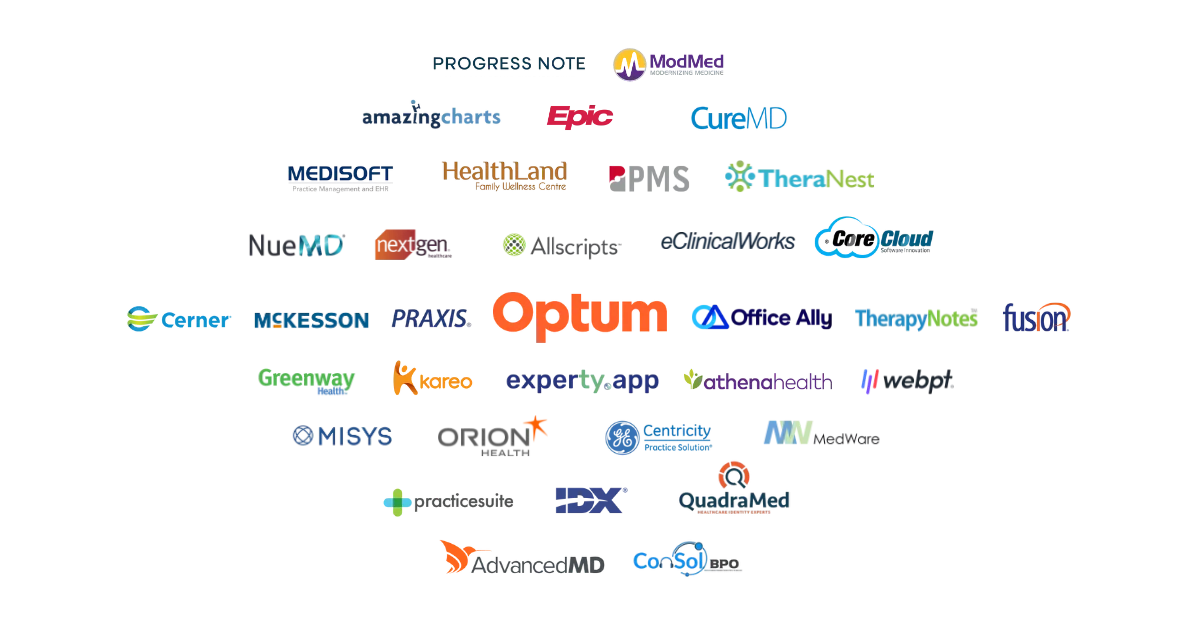
Which EHR and practice management systems do we work with?
We work inside the system you already use. No forced migration and no retraining your front desk on new software.
- Experity, athenahealth, eClinicalWorks, NextGen, Epic, Oracle Health (Cerner), AdvancedMD, Tebra (Kareo), DrChrono, Practice Fusion, Greenway Health, Meditech, ModMed
Running something else? Ask during your free audit. We’ll tell you plainly whether we can work in it.
How much do urgent care billing services cost?
We charge a percentage of what we collect for you, typically 4 to 8 percent depending on visit volume, payer mix, and the services you need. Our fee only comes out of money we actually bring in.
- No setup fees
- No long term contracts
- No charge for the free billing audit before you sign
Run the math on your own center. Say you see 1,500 visits a month and collect an average of 140 dollars per visit. If 12 percent of claims deny and your team only reworks half of them, you lose about 12,600 dollars every month. That figure usually covers a billing partner’s fee with room to spare.

| Factor | In-house team | Medicotech |
|---|---|---|
| Cost structure | Salaries, benefits, software, and training | A percentage of collections, no setup fee |
| Peak day coverage | Depends on who shows up | Our team scales with your volume |
| Coding credentials | Varies by hire | CPC certified billers and CCS certified coders |
| Turnover risk | You retrain every time a biller leaves | We handle staffing on our side |
| Payer rule tracking | Fits between other tasks | A team that tracks S code policy, downcoding, and ICD-10 updates |
| Reporting | Someone pulls numbers when they find time | Weekly KPI reports |
Want to see everything we handle beyond urgent care? Our outsourced medical billing services page covers all 50 plus specialties we support.
In house or : outsourced which urgent care billing model fits your center?
Outsourcing makes sense when your volume swings, your billers turn over, or your payer rules change faster than your team can track. An in house team makes sense when you have stable staff, strong coders, and time to keep up with policy changes.
In house vs outsourced urgent care billing
Transparent Reporting & Urgent Care Specialized Billing
You see the same numbers we see every week. Our clean claim rate sits at 96%, keeping your revenue cycle predictable and fully compliant.
First Month Trackable Metrics

Why Operators Choose Medicotech
Urgent Care Specific Coding
Coders routinely manage S9083 routing, modifier 25 support, CLIA rules, and occupational medicine billing.
Transparent Reporting
Never ask where a claim stands—weekly reports detail every single dollar across your revenue pipeline.
No Lock-In Contracts
We earn your business every month by maximizing collections without forcing long-term commitments.
HIPAA Compliant Handling
Strict data security via encrypted transfers, role-based access controls, and ongoing compliance training.
very week a denied claim sits unworked, it gets harder to collect. Our urgent care billing team reviews your last 90 days of claims, maps your payer contracts, and shows you exactly where revenue slips between check in and payment.
Frequently Asked Questions
What are urgent care billing services?
Urgent care billing services manage the money side of every walk in visit. That covers eligibility checks, coding the visit and any procedures, claim submission, payment posting, denial appeals, A/R follow up, and patient statements. A specialized team also handles urgent care quirks like S9083 routing, POS 20, modifier 25, CLIA waived lab billing, and employer billing for occupational medicine.
How is urgent care billing different from emergency room billing?
Urgent care centers bill office and outpatient E/M codes (99202 to 99215) with POS 20, while emergency departments bill ED codes (99281 to 99285) with POS 23 and usually a hospital facility fee. Urgent care claims also carry more payer specific rules, such as S9083 global fees, which emergency departments don’t use. Mixing the two code sets causes fast denials.
When should an urgent care center bill S9083?
Bill S9083 only when the patient’s payer contract says to. S9083 pays one global fee for the whole urgent care visit, and some commercial plans and Medicaid programs require it. Other payers expect itemized E/M and procedure codes and deny S9083 outright. We keep a payer routing table so the right model goes out on every claim.
Does Medicare pay S9083?
No. Medicare doesn’t recognize HCPCS S codes, including S9083 and S9088. For Medicare and most Medicare Advantage patients, you bill the E/M level that matches the visit plus each separately payable procedure, test, and drug. Sending S9083 to a Medicare contractor produces a denial and delays payment for the whole visit.
Can urgent care bill an E/M visit and a procedure on the same day?
Yes, when the provider performed a significant, separately identifiable evaluation beyond the usual work of the procedure. You add modifier 25 to the E/M code. The note needs its own assessment and plan for the visit, separate from the procedure note. Without that support, payers bundle the visit into the procedure and pay only once.
What place of service code do urgent care centers use?
Freestanding urgent care centers use POS 20, the CMS code for an urgent care facility. Hospital owned sites may use POS 19 or 22 depending on whether they sit off or on the hospital campus. Telehealth visits use POS 02 or 10. A wrong POS default in your EHR misprices every claim from that location.
Can urgent care centers bill after hours codes like 99051?
Sometimes. Codes 99050 and 99051 report services outside regular hours or during evening, weekend, and holiday hours. Some commercial payers pay them as add ons. Medicare bundles them and won’t pay separately. We check each payer’s policy and only send these codes where they pay, so they don’t trigger needless denials.
How do you handle self pay and uninsured patients?
We run coverage discovery first, because many self pay patients actually have active insurance. For true self pay patients, we bill from your self pay fee schedule and send clear statements. When an uninsured or self pay patient asks for a cost estimate, the No Surprises Act requires a good faith estimate, and we help you produce it.
Do you bill workers' compensation and occupational medicine?
Yes. We bill workers’ comp carriers under each state’s fee schedule and keep claim numbers, adjuster contacts, and injury dates attached to every visit. For employer services like pre employment physicals, drug screens, and DOT exams, we run a separate invoicing track with its own aging report, so no employer receivable ages past 90 days unnoticed.
How much does it cost to outsource urgent care billing?
Medicotech charges a percentage of collections, typically 4 to 8 percent depending on visit volume, payer mix, and the services you choose. We don’t charge setup fees or lock you into a long term contract. You start with a free billing audit, so you see your current denial patterns before you decide.
How long does it take to switch to a new urgent care billing company?
Timing depends mostly on EHR access and how many payers need updated enrollment or ERA setup. We map the full transition plan during your free audit. During the switch, we can work your existing A/R alongside new claims, so your cash flow doesn’t stall while the old and new processes overlap.
How do you fight automatic downcoding from payers?
We start with documentation. Our coders audit your E/M level distribution by provider each month, so your notes support the levels you bill. When a payer downcodes a level 4 or 5 visit, we appeal with the medical decision making or time documentation attached. We also track downcode patterns by payer and share them with your leadership.
Is Medicotech HIPAA compliant?
Yes. Medicotech operates as a HIPAA compliant business associate and signs a business associate agreement with every client. We use encrypted data transfer, role based access, and regular staff training to protect patient information. Our team only accesses the records it needs to code, bill, and follow up on your claims.