
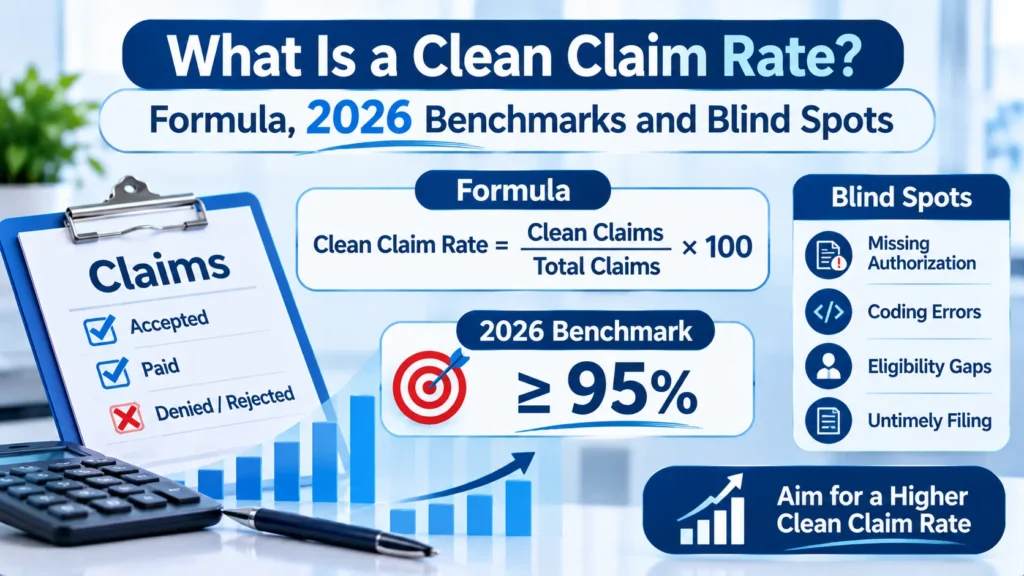
A clean claim rate is the percentage of your claims that pass every edit and reach the payer without a correction, a rejection, or a request for more information on the first submission. You calculate it by dividing clean claims by total claims submitted, then multiplying by 100. Most benchmark tables set the bar at 95 percent, and top billing teams aim for 98. The number has limits, though, and this guide covers those too.
Here’s the uncomfortable part. Your clearinghouse dashboard can show 97 percent while payers deny one claim in seven. Both numbers can be true in the same month.
If your practice bills more than 500 claims a month, this applies to you. A few points of difference between “accepted” and “paid” adds up to real money before the quarter ends.
Key takeaways
- Clean claim rate = (clean claims ÷ total claims submitted) × 100.
- Four different checkpoints can each produce a “clean claim rate.” Ask which one your report uses.
- Aim for 95 percent or higher at payer acceptance. Treat anything under 90 as a front end problem.
- A clean claim can still come back denied or underpaid, so track first pass payment rate beside it.
- Most dirty claims start at registration, eligibility, and authorization, long before billing touches them.
What is a clean claim?
A clean claim is a claim the payer can process without asking anyone for anything else. No missing subscriber ID. No invalid modifier. No absent authorization number.
Three sources define it, and they don’t fully agree:
- Medicare. The Medicare Claims Processing Manual (Chapter 1, Section 80.2) treats a claim as clean when the contractor doesn’t have to investigate or develop information outside its own Medicare operation before paying.
- Medicaid. Federal regulation 42 CFR 447.45 on timely claims payment calls a claim clean when the agency can process it without getting more information from the provider or a third party.
- HFMA. The HFMA MAP Key for clean claim rate (CL-1) counts claims that pass edits with no manual intervention, divided by all claims your claims processing tool accepted for billing.
Notice the gap. Regulators define clean from the payer’s side of the desk. HFMA measures it inside your own billing software, before the claim ever leaves the building. That difference drives most of the confusion around this metric.
Why does clean status matter for cash flow?
Clean status starts the payer’s payment clock. Medicare contractors must pay or deny a clean claim within 30 days of receipt, and they owe interest when they miss that ceiling. Clean electronic claims can pay as early as day 14. State Medicaid agencies must pay 90 percent of clean practitioner claims within 30 days and 99 percent within 90 days. Commercial plans follow state prompt pay laws, and those deadlines vary by state.
A claim that isn’t clean gets none of those protections. It waits.
How do you calculate clean claim rate?
Divide the number of clean claims by the total number of claims you submitted in the same period, then multiply by 100.
Say your practice submitted 1,200 claims in October and payers accepted 1,128 on the first submission. Your clean claim rate is (1,128 ÷ 1,200) × 100, or 94 percent. The other 72 claims needed a fix before they could move.
The clean claim rate formula looks simple. The inputs cause the trouble. Hold your report to four rules:
- Match the period. Pull the numerator and the denominator from the same submission dates.
- Count first submissions only. A corrected claim that passes on its second try was never clean.
- Pick a unit and keep it. Claim level and line level counts produce different rates. Don’t switch between months.
- Exclude nothing quietly. Secondary claims, paper claims, and workers’ comp belong in the count unless the report says otherwise in writing.
Which clean claim rate are you actually looking at?
You’re looking at one of four numbers, because a claim passes four checkpoints and each one can call it clean. Vendors rarely say which checkpoint they used.
Take an Internal Medicine practice in Tampa that submits 1,200 claims in a month. The figures below are illustrative, and the pattern is common.
Same practice, same month, four defensible answers. The spread between 97 and 85 percent equals 144 claims. At an average of 150 dollars per claim, that’s 21,600 dollars that needed extra work or extra weeks to arrive.
Most practice managers celebrate the first number without asking who calculated it. We think checkpoint 3 is the fairest place to measure a clean claim rate, and checkpoint 4 is the number that should run your Monday meeting.
What is a good clean claim rate in 2026?
A good clean claim rate is 95 percent or higher, measured at payer acceptance. Top billing operations hold 98 percent. A rate that stays under 90 percent for more than a month points to a systemic front end problem.
Where do these clean claim rate benchmarks come from?
Mostly from convention. Vendors often credit the 98 percent target to HFMA and the 95 percent floor to MGMA. HFMA’s public MAP Key page gives the formula for clean claim rate and lists no target next to it.
The medians tell a humbler story. A Forvis Mazars session at the Kansas MGMA conference in April 2026 cited MGMA DataDive figures that put the median clean claim rate for family medicine practices at 85 percent (2023 data). So treat 95 as a target. Don’t assume your peers already hit it.
Denial data backs that up. Experian Health’s State of Claims 2026 survey found that 40 percent of providers see payers deny 10 percent or more of their claims, up from 31 percent in 2022. TriZetto Provider Solutions analyzed roughly 630 million professional claims for its 2026 payments report card and found an average denial rate of 14.6 percent across payers.
Specialty matters too. Practices with heavy authorization and documentation requirements, behavioral health for example, typically run below primary care. Compare yourself to your own specialty and payer mix before you compare yourself to a national figure.
For reference, Medicotech reports a 96 percent clean claim rate and a 97 percent net collection rate.
Clean claim rate vs first pass payment rate vs denial rate: what’s the difference?
Clean claim rate tells you whether you built the claim correctly. First pass payment rate tells you whether the payer paid it without rework. Denial rate tells you how often the payer said no. You need all three, because each one covers a gap the others leave open.
Two of these terms trip people up constantly. A rejection bounces before the payer adjudicates the claim. A denial arrives after. Our guide to the difference between a claim rejection and a denial walks through what to do with each.
First pass payment rate comes from your remittance data. If your team still posts from paper, read our comparison of EOB and ERA payment posting first, because you can’t measure first pass payment reliably without electronic remits.
What does a clean claim rate hide?
A clean claim rate hides everything that happens after the payer accepts the claim, plus several things that happen before. Six blind spots cost practices the most.
1. It stops at the front door
Acceptance means the payer agreed to look at the claim. Payment comes later, or doesn’t. The TriZetto analysis above found payers denying 14.6 percent of professional claims on average, and every one of those claims had already cleared acceptance.
2. It can’t see underpayments
A payer can accept your claim, adjudicate it, and pay less than your contract allows. The same TriZetto report found roughly 4.9 percent of claims underpaid, and those payments landed about 27 percent below the allowed amount. Your clean claim rate counts each of them as a success.
3. A blended rate buries your worst payer
One number across all payers averages away the problem. A practice can show 96 percent overall while a single Medicaid managed care plan sits at 82. You only find it when you split the report by payer, by provider, and by location.
4. Whoever builds the report picks the denominator
Some reports drop claims that staff fixed before submission. Others leave out secondary claims or count resubmissions as new clean claims. Each choice lifts the rate without improving a single claim.
5. It ignores effort
At the clearinghouse checkpoint, a claim your biller touched three times before sending still counts as clean. HFMA’s definition is stricter for a reason. Manual touches cost staff hours, and a rate that hides them hides your real cost to collect.
6. It goes stale fast
Payers change their edits without much notice. In HFMA’s 2026 Vitalic Health study of clean claims, 69 percent of surveyed revenue cycle professionals said payers use proprietary edits, and 42 percent of providers maintain more than 100 edits per payer. Last quarter’s 97 percent says little about a rule a payer added last week.
Stop Paying Twice for the Same Denial
A claim that clears every edit and still comes back with CO-16 or CO-197 costs you twice, once in rework and again in delayed cash. Our denial management services give you a dedicated specialist who traces each denial to its source and appeals what payers owe you. Talk with our team about your top denial codes this quarter.
What causes a low clean claim rate?
Most dirty claims start at the front desk and the charge entry screen, long before a biller sees them. TriZetto’s 2026 analysis traced more than 66 percent of denials to front end and mid cycle steps. In a January 6, 2026 MGMA Stat poll on revenue cycle leaks, 48 percent of medical group leaders named denials and appeals as their biggest leak, and another 23 percent named front end issues.
The usual suspects:
- Eligibility lapses. Coverage ended, the plan changed, or the patient now has a Medicare Advantage plan.
- Demographic mismatches. A name, birth date, or subscriber ID doesn’t match the payer’s file.
- Missing or expired pre authorization. The approval covers different dates, units, or CPT codes than the claim.
- Coding conflicts. ICD-10 codes lack specificity, modifier 25 lacks support, or a code pair trips an NCCI edit.
- Provider enrollment gaps. A new provider sees patients before the payer finishes credentialing.
- Coordination of benefits errors. The claim goes to the secondary plan first.
- Form field errors. A wrong qualifier or an empty box on the claim form triggers a rejection. Our CMS-1500 box by box instructions cover the fields that reject most often.
Picture a Tuesday at a four provider Internal Medicine office. A patient moved from a BCBS PPO to a Medicare Advantage plan on the first of the month. The front desk copies the insurance from the last visit. The claim sails through the scrubber, because the old member ID still has a valid format. BCBS denies it nine days later. The corrected claim to the right plan now needs an authorization nobody requested.
No scrubber catches that. Only a fresh eligibility check does, which is why insurance eligibility verification before every visit moves this metric more than any software setting.
How do you improve your clean claim rate?
You improve clean claim rate by fixing the step that creates the error, then confirming the fix in next week’s rejection report. Seven moves do most of the work.
- Verify eligibility twice. Check at scheduling and again 24 to 48 hours before the visit. Confirm the plan, the effective dates, and the copay.
- Tie every authorization to the claim. Record the authorization number, date range, units, and approved CPT codes where your biller can see them.
- Send errors back to their source. Give the front desk a weekly count of rejections by error type. People fix what they can see.
- Code against payer policy. Check NCCI edits, modifier rules, and diagnosis specificity before charge entry closes. Certified coders (CPC or CCS) catch conflicts that generic edits miss, and that’s the daily job of our medical coding team.
- Give your scrubber an owner. Name one person who updates payer rules whenever a payer bulletin lands. A scrubber running last year’s edits passes this year’s denials.
- Work rejections within 24 hours. A rejected claim hasn’t reached the payer yet, and the timely filing clock keeps running.
- Enroll before you bill. Confirm each new provider’s payer enrollment, NPI, and taxonomy code before the first claim goes out.
None of this is glamorous. It’s a checklist, repeated daily, and it’s the core of what outsourced medical billing services should deliver for a practice your size.
Want to know how to improve clean claim rate fastest? Start with step 1. Eligibility errors are the cheapest to prevent and the most expensive to chase.
What changed for clean claims in 2026?
Three developments changed the ground under this metric in 2026: new prior authorization deadlines, an industry push to standardize claim edits, and denial rates that refuse to drop.
Prior authorization deadlines. Under the CMS Interoperability and Prior Authorization final rule (CMS-0057-F), Medicare Advantage, Medicaid, and CHIP payers must now decide standard requests within 7 calendar days and urgent requests within 72 hours. They must also give a specific reason for each denial. CMS explains the requirements in its 2026 update on prior authorization reform. Practices haven’t felt much relief yet. In a September 1, 2026 MGMA Stat poll, 44 percent of medical group leaders said payer turnaround got slower this year. The electronic prior authorization API requirements arrive January 1, 2027.
Claim edit standardization. HFMA’s Vitalic Health initiative surveyed 64 revenue cycle professionals from 54 organizations and proposed a national claim edit library plus a change notification system for payer rule updates. You can read the findings in the HFMA clean claims study brief. Until that library exists, your team carries the burden of tracking each payer’s edits.
Measurement gaps. Experian’s 2026 survey found that only 31 percent of respondents use clean claim rate to measure progress on denials, and 23 percent use denial rate. Plenty of organizations still fly without either gauge.
One standing reminder. ICD-10 updates take effect every October 1 and CPT updates every January 1. Put both dates on your scrubber owner’s calendar.
What should you ask your biller about this number?
Ask where the number comes from before you trust it. Five questions separate a real clean claim rate from a flattering one, whether an employee or a billing company produces your report.
- At which checkpoint do you measure it: scrubber, clearinghouse, payer acceptance, or payment?
- Which claims does the denominator leave out?
- Can I see the rate by payer, by provider, and by location?
- What was our first pass payment rate for the same month?
- What were the top five rejection reasons, and what did we change upstream for each?
If the first question gets a shrug, you’ve found your first blind spot.
Clean claim rate FAQs
What is a good clean claim rate for a small practice?
Aim for 95 percent or higher, measured at payer acceptance. Top billing teams hold 98 percent. If your rate stays under 90 percent for more than a month, look at registration and eligibility first, since those two steps create most rejections in small practices.
How do you calculate clean claim rate?
Divide the claims that passed on first submission by the total claims you submitted in the same period, then multiply by 100. A practice that submits 400 claims and gets 372 accepted on the first try has a 93 percent clean claim rate.
What’s the difference between clean claim rate and first pass payment rate?
Clean claim rate counts claims the payer accepted on first submission. First pass payment rate counts claims the payer actually paid on first adjudication without rework. The second number always runs lower, and the gap between them shows how many accepted claims payers later denied or pended.
Can a payer still deny a clean claim?
Yes. Clean means the claim carried complete, valid data. The payer can still deny it for medical necessity, a missing authorization, a coverage exclusion, or a duplicate. That’s why you track denial rate and first pass payment rate beside clean claim rate.
What is the difference between a claim rejection and a claim denial?
A rejection happens before adjudication. The clearinghouse or payer returns the claim for a format or data error, and you fix and resubmit it. A denial happens after the payer processes the claim and refuses payment. Denials need a corrected claim or an appeal.
How long does a payer have to pay a clean claim?
Medicare contractors must pay or deny clean claims within 30 days and owe interest after that. State Medicaid agencies must pay 90 percent of clean practitioner claims within 30 days and 99 percent within 90 days. Commercial deadlines depend on your state’s prompt pay law.
Why is my clean claim rate different for each payer?
Each payer runs its own edits, authorization lists, and enrollment rules. A claim format that passes Aetna can reject at a Medicaid managed care plan. Split your rate by payer every month, and fix the lowest one first.
How often should I measure clean claim rate?
Review it weekly and report it monthly. A weekly look catches a new payer edit or a front desk error within days. Wait a full quarter and the same error can spread across hundreds of claims and push some past timely filing limits.
What should I do if my clean claim rate drops suddenly?
Pull the rejection report for the last two weeks and sort it by payer and by reason. A sudden drop usually traces to one cause: a payer rule change, a new staff member, a software update, or a provider enrollment lapse. Fix that cause, then resubmit.
Does claim scrubbing software guarantee a high clean claim rate?
No. A scrubber only catches errors its rules know about. It can’t tell that a patient changed plans last week, and it misses new payer edits until someone loads them. Pair it with eligibility checks and a person who owns rule updates.
Is a 100 percent clean claim rate realistic?
Not for long. Payers change rules, patients change coverage, and people make typos. A practice reporting 100 percent every month probably measures at the scrubber or trims the denominator. A steady 97 to 98 percent at payer acceptance is excellent.
So, is your clean claim rate telling you the truth?
It’s telling you part of it. A clean claim rate measures how well your practice builds claims, and that’s worth knowing every week. It can’t tell you whether payers paid those claims, paid them correctly, or paid them on time.
Measure it at payer acceptance. Split it by payer. Put first pass payment rate and denial rate on the same page. Then chase the gap between them, because that gap is where your cash sits.
Get a Free Review of Your Last 90 Days
A clean claim rate only helps when someone measures it at the right checkpoint and acts on what it shows. Our medical billing team scrubs every claim against payer specific rules and checks eligibility in real time, so more claims pay on the first pass. Start with a free billing audit of your last 90 days of claims.