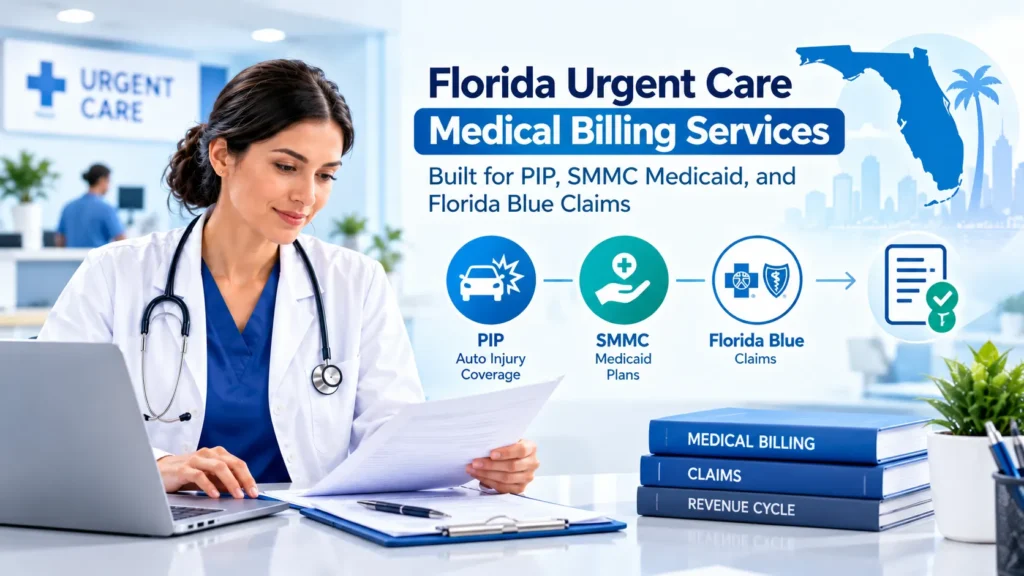
Florida urgent care medical billing services cover every money step of a walk-in visit under Florida rules. That means eligibility checks, E/M and procedure coding, claims to Florida Blue and SMMC Medicaid plans, PIP auto injury billing under the 14-day rule, workers’ comp billing against the state fee schedule, and the self-pay price list that Florida Statute 395.107 requires. Medicotech runs that full cycle from St. Petersburg for urgent care centers across the state. Learn more about our medical billing services in Florida.
Florida isn’t a typical urgent care market. You bill a no fault auto system that only a handful of states still run, a Medicaid program that sits almost entirely inside managed care plans, and a Blue plan with its own network rules. Miss one Florida detail and the claim stalls. This guide works as the Florida companion to our urgent care medical billing services page, and it goes deep on the rules that only apply here.
If your center sees more than 40 patients on a Saturday, every section below affects your cash.
Florida urgent care billing at a glance (October 2026)
What makes urgent care billing in Florida different?
Four Florida rules change how an urgent care claim gets paid: PIP no fault auto coverage, the SMMC Medicaid structure, the state workers’ comp fee schedule, and the posted price list for self pay patients. A generic national playbook handles none of them well.
Most billing companies write one urgent care workflow and run it in every state. That works fine in Ohio. Here, some of your most valuable claims never touch a health plan at all. They go to an auto insurer’s PIP adjuster or a workers’ comp carrier, and each one brings its own forms, deadlines, and fee schedule.
So the fix starts at the front desk, long before a coder opens the chart. Strong eligibility checks and accurate claim handling, supported by effective denial management services, can help Florida urgent care centers reduce preventable denials and recover delayed revenue.
How does PIP billing work for Florida urgent care centers?
Florida requires drivers to carry $10,000 in personal injury protection. The injured patient must receive initial care within 14 days of the crash, and the full $10,000 only applies when a qualifying provider documents an emergency medical condition (EMC). Without that finding, PIP medical benefits cap at $2,500.
The 14 day rule starts at registration
Your front desk owns this one. Ask every injury patient two questions at check in: did this happen in a car, and on what date? A crash 16 days back means PIP won’t pay the initial visit, no matter how clean your coding looks.
Picture a Monday morning at an urgent care center in Clearwater. A delivery driver walks in with neck pain and says the fender bender happened “a couple weeks ago.” Registration bills her health plan. Three weeks later, the plan sends back a coordination of benefits denial (CARC 22) because auto coverage should pay first. By then, the 14 day window closed long ago. (This is an illustrative scenario, not a patient record.)
One extra intake question would have routed that claim correctly on day one.
Who can document an emergency medical condition?
Under Florida’s PIP statute, a medical doctor, osteopathic physician, dentist, physician assistant, or advanced practice registered nurse can determine that the patient had an EMC. Urgent care staffing fits that list well. The note still needs to state the finding in plain words, because adjusters won’t infer it from a pain score.
What does PIP actually pay?
Insurers can limit payment to 80 percent of a schedule set at 200 percent of the Medicare Part B participating physician fee schedule. The Medicare schedule in effect on March 1 sets the PIP rate for the rest of that year. We load that schedule into your posting rules, so your team spots a short payment the day the EOB arrives. You can read the full rules in Florida Statute 627.736 on required PIP benefits.
Is PIP going away in 2026?
Not yet. Lawmakers filed repeal bills again in the 2025 and 2026 sessions, and none became law. Governor DeSantis vetoed the last repeal that cleared both chambers, back in 2021. We watch every session, so your workflow changes the same week the law does.
Here’s our honest take. Most Florida urgent care operators treat PIP as a side line. It deserves its own intake script, its own claim route, and its own aging report.
Which Florida Medicaid plans do urgent care centers bill?
Florida runs Medicaid through Statewide Medicaid Managed Care (SMMC), which the Agency for Health Care Administration (AHCA) oversees. Most Medicaid patients who walk into your center belong to a managed care plan from the current contract cycle, and fee for service Medicaid covers only a small slice of enrollees.
Plans you’ll see on Medicaid cards include:
- Sunshine Health
- Simply Healthcare Plans
- Humana Medical Plan
- Aetna Better Health of Florida
- UnitedHealthcare Community Plan
- Molina Healthcare of Florida
- Community Care Plan
- Florida Community Care
Availability depends on the AHCA region, so a plan that covers your Orlando site may not cover your Fort Myers site. Patients also switch plans more often than they replace their cards. We run real time eligibility against the plan on file and the state system on every visit, because a Medicaid card from last spring proves nothing today.
Each plan also sets its own position on S9083 global billing versus itemized E/M. Our S9083 versus S9088 breakdown explains how those two codes behave, and we map each SMMC plan’s rule from your actual contract.
Which commercial payers matter most for Florida urgent care billing?
Florida Blue carries the largest commercial book in the state, followed by UnitedHealthcare, Aetna, Cigna, Humana, and AvMed. Medicare Advantage also runs heavy in Florida, so many patients over 65 carry a private plan card instead of a red, white, and blue Medicare card.
What we check on Florida urgent care claims by payer
Medicare never pays S9083 or S9088. Send either code to First Coast and the whole visit denies, so we bill itemized E/M plus procedures for every traditional Medicare patient.
How do Florida prompt pay laws protect urgent care cash flow?
Florida law gives state regulated health insurers 20 days to pay, deny, or contest a clean electronic claim. They must pay or deny within 90 days. After 120 days of silence, the insurer owes the claim, and overdue payments carry 12 percent simple interest per year.
Paper claims run on longer clocks (40 days to act, 120 days to pay or deny). That alone justifies electronic submission for every payer that accepts it.
Few practice managers ever enforce these rules. We do. Our team tracks each acknowledgment, flags claims at day 21 with no decision, and calculates the interest owed when a payment shows up late. The statute sits at Florida Statute 627.6131 on payment of claims. One caveat: self funded employer plans fall under federal ERISA rules, so the Florida clock doesn’t apply to them.
How do you bill workers’ comp for Florida urgent care visits?
You bill Florida workers’ comp on the CMS-1500 (the state calls it Form DFS-F5-DWC-9) and get paid under the Division of Workers’ Compensation Health Care Provider Reimbursement Manual. Physicians also report the injured worker’s treatment and work status on Form DFS-F5-DWC-25.
The 2025 edition of the health care provider fee schedule took effect January 1, 2026, and the state has already posted the 2026 edition for January 1, 2027. We update your rates before each change, not after the first short payment. You’ll find the schedules on the Florida Division of Workers’ Compensation site.
Two habits protect your comp revenue:
- Attach the DWC-25 to every bill that needs it, since a missing report gives the carrier a reason to stall.
- Never bill the injured worker for a compensable injury. Florida law puts that cost on the carrier, and a patient statement can trigger a complaint.
Employer services such as pre employment physicals, drug screens, and DOT exams run on a separate invoice track with its own aging report.
What does Florida Statute 395.107 require from urgent care centers?
Florida requires every urgent care center to publish and post a schedule of charges in plain language. The schedule lists prices for uninsured patients paying by cash, check, or card, and it must cover the 50 services your center provides most often.
You can group those services into three price tiers and post them on a board or an electronic display in the reception area. Hospital affiliated centers must also tell insured patients whether charges match or exceed the affiliated hospital’s charges. Centers that fail to post face fines of up to $1,000 per day. Employer owned clinics that serve only employees and their dependents get an exemption. The text lives in Florida Statute 395.107.
Why does a billing company care about a wall sign? Because your practice management system has to charge the same tier prices the board shows. When the two drift apart, self pay patients dispute bills and your front desk eats the conflict. We match your self pay fee schedule to the posted tiers and produce the federal good faith estimate when an uninsured patient asks for one.
What are the most common Florida urgent care billing denials?
Most Florida urgent care denials trace back to intake, not coding. Wrong payer routing on accident cases, stale Medicaid plan data, and missing modifier support cause the bulk of the rework we see.
Florida urgent care denials and how we prevent them
Eliminate Florida Urgent Care Claim Denials
Eligibility misses and PIP routing errors pile up fastest on your busiest weekends. Our denial management team for urgent care claims traces each Florida denial back to the intake or coding step that caused it, fixes that step, and appeals what payers still owe you. Talk with our team about your current denial patterns.
How does Medicotech handle Florida urgent care billing?
We run a six step workflow built around Florida’s payer mix. It starts with your contracts and ends with a weekly report you can read in five minutes.
- Map your Florida payers. We pull your Florida Blue, SMMC, commercial, PIP, and workers’ comp contracts and build a routing table for S9083, E/M, and fee schedule rules.
- Fix intake. Your front desk gets an accident and work injury script, and our team can check coverage before the provider walks in.
- Code every chart. CPC certified billers and CCS certified coders on our medical coding services team check E/M levels, modifier 25, POS 20, and CLIA requirements.
- Route each claim. Health plan, PIP carrier, comp carrier, employer invoice, or self pay. Each one follows its own path.
- Post and enforce. We post ERAs and EOBs, compare payments to contract and PIP rates, and enforce Florida prompt pay deadlines.
- Report weekly. You see clean claim rate, denial rate by reason, days in A/R, and revenue per visit by site.
Running other specialties too? Our Florida medical billing team supports practices statewide beyond urgent care.
Should a Florida urgent care center keep billing in house or outsource it?
Outsource when your visit volume swings with tourist season, your billers turn over, or PIP and comp claims age past 60 days. Keep billing in house when you have stable staff who already know Florida’s PIP, SMMC, and comp rules cold.
In house versus outsourced urgent care billing in Florida
How much do Florida urgent care billing services cost?
Medicotech charges a percentage of what we collect for you, typically 4 to 8 percent depending on visit volume, payer mix, and the services you choose. You pay no setup fee, sign no long term contract, and get a free billing audit before you decide.
Run the math on your own center. Say you see 1,200 visits a month and collect an average of 135 dollars per visit. If 10 percent of claims deny and your team reworks only half of them, you lose about 8,100 dollars every month. That number usually covers a billing partner’s fee with room to spare.
Our team works from St. Petersburg, holds a 96 percent clean claim rate across 100,000 plus processed claims, and bills for 50 plus specialties nationwide. Our outsourced medical billing services page covers the full scope.
Maximize Your Florida Urgent Care Revenue
Florida urgent care billing rewards the centers that get intake, PIP routing, and payer rules right from the first visit. Our urgent care billing specialists review your last 90 days of claims, map your Florida payer contracts, and show you exactly where revenue slips. Book a free billing audit and see the gaps before they cost another month.
Frequently asked questions about Florida urgent care billing
Do Florida urgent care centers have to post their prices?
Yes. Florida Statute 395.107 requires urgent care centers to publish and post a plain language schedule of charges for uninsured patients. The schedule must cover the 50 services the center provides most often and can group them into three price tiers. Centers that skip it face fines of up to $1,000 per day, while employer owned clinics serving only employees get an exemption.
How long does a patient have to get care for Florida PIP to pay?
The patient must receive initial services and care within 14 days of the motor vehicle accident. If the first visit happens on day 15 or later, PIP can deny medical benefits entirely. That’s why we add an accident date question to your urgent care intake and route crash related visits to the auto carrier from the start.
Can an urgent care provider certify an emergency medical condition for PIP?
Yes, if the provider is a medical doctor, osteopathic physician, dentist, physician assistant, or advanced practice registered nurse. An EMC finding opens the full $10,000 PIP benefit. Without it, benefits stop at $2,500. The provider’s note should state the EMC determination clearly, because adjusters look for explicit language.
Does Medicare pay S9083 for Florida urgent care visits?
No. Medicare doesn’t recognize HCPCS S codes, including S9083 and S9088. For traditional Medicare patients in Florida, you bill the E/M level the note supports plus each separately payable procedure, test, and drug, with POS 20 for a freestanding urgent care center. First Coast Service Options processes those Part B claims.
How fast must Florida insurers pay urgent care claims?
For clean electronic claims, Florida Statute 627.6131 gives state regulated insurers 20 days to pay, deny, or contest. They must pay or deny within 90 days, and silence past 120 days makes the claim payable. Late payments carry 12 percent simple interest per year. Self funded employer plans follow federal ERISA rules instead.
Which forms do Florida urgent care centers use for workers’ comp billing?
You bill professional services on the CMS-1500, which Florida designates as Form DFS-F5-DWC-9. Physicians report the injured worker’s treatment and work status on Form DFS-F5-DWC-25. Payment follows the Division of Workers’ Compensation Health Care Provider Reimbursement Manual, and the injured worker never receives a bill for a compensable injury.
Did Florida repeal PIP in 2026?
No. Lawmakers filed repeal bills in the 2025 and 2026 sessions, but none passed both chambers and reached the governor’s desk. PIP remains mandatory, and the 14 day rule and $10,000 benefit still apply. We track each legislative session and will update your billing workflow if Florida ever moves to a bodily injury system.
Which Medicaid plans do Florida urgent care centers bill?
Most Florida Medicaid patients belong to an SMMC managed care plan such as Sunshine Health, Simply Healthcare, Humana Medical Plan, Aetna Better Health, UnitedHealthcare Community Plan, Molina, or Community Care Plan. Plan availability varies by AHCA region. Your center needs credentialing with each plan and a real time eligibility check at every visit.
How much do Florida urgent care billing services cost?
Medicotech charges 4 to 8 percent of collections, depending on visit volume, payer mix, and the services you need. You pay no setup fee and sign no long term contract. Every engagement starts with a free billing audit that reviews your last 90 days of claims and shows where revenue leaks.
Do you work with urgent care centers outside Tampa Bay?
Yes. Our team works remotely inside your EHR, so we bill for urgent care centers in Miami, Orlando, Jacksonville, Tallahassee, Fort Myers, Pensacola, and everywhere in between. Our St. Petersburg headquarters gives us close knowledge of Florida payers, but location never limits who we can support.