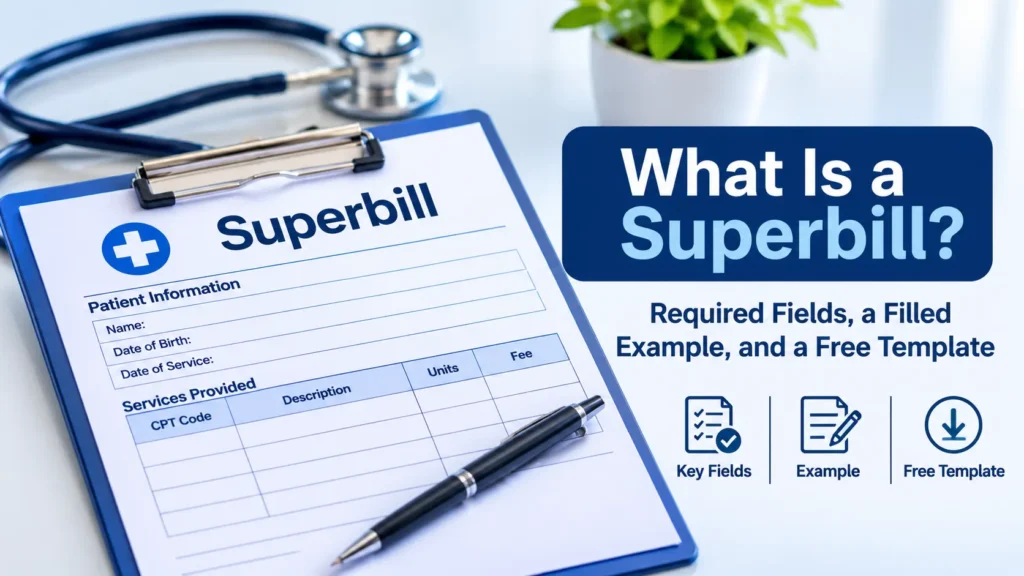
A superbill is an itemized record of a patient visit that lists the provider, the patient, the dates of service, the CPT procedure codes, the ICD-10 diagnosis codes, and the fees. Despite the name, it asks nobody for money. The patient pays you first, then sends the superbill to their insurer to claim out of network reimbursement. Some practices also use the term for the internal encounter form that feeds the billing team.
Most guides stop at the definition. This one gives you the 16 fields payers look for, a filled superbill medical billing example from an internal medicine visit, a blank superbill template you can copy today, and the cases where a superbill won’t work at all. Medicare is the big one.
If your practice sees even ten out of network or cash pay patients a month, this applies to you.
What is a superbill in medical billing?
In medical billing, a superbill is the coded summary of one patient encounter. It pairs each service (a CPT or HCPCS code) with the diagnosis that justifies it (an ICD-10 code) and adds the provider and patient identifiers an insurer needs to process a claim. You’ll also hear it called an encounter form, a charge slip, or a fee ticket.
The word covers two different documents. Mixing them up causes real confusion at the front desk.
The patient facing superbill
This is the version most people mean. An out of network or cash pay practice collects payment at the visit, then hands the patient a superbill. The patient files it with their own insurer. If the plan includes out of network benefits, the insurer reimburses the patient directly. Your practice never touches the claim.
Who issues them? Therapists and psychiatrists write the most, followed by concierge physicians, chiropractors, physical therapists, and dietitians.
The internal encounter form
In network practices use a superbill too, but the patient never sees it. The provider marks the services and diagnoses after the visit, and the billing team turns that record into a CMS-1500 claim. Most EHRs (Epic, athenahealth, AdvancedMD, eClinicalWorks) now build this form electronically from the visit note. Teams that rely on outsourced medical billing services send this record to their billers every day.
The rest of this guide focuses on the patient facing version. That’s the one you have to get right with no clearinghouse checking your work.
What fields does a superbill need?
A superbill needs 16 data points across four groups: provider, patient, visit, and payment. No federal rule sets a format, and neither HIPAA nor CMS publishes an official superbill form. But insurers review patient claims against the same data that sits on the CMS-1500, so a superbill that mirrors those boxes moves faster.
Add two more when they apply: the referring provider’s name and NPI (boxes 17 and 17b), and any pre authorization number (box 23).
Three of these fields rarely appear on the free templates floating around online: the diagnosis pointer, the place of service code, and units. Skip them and the insurer’s claims processor has to guess. That often ends with a letter to your patient asking for more information.
Our view: most practices hand the superbill to the wrong person. The front desk prints it, the provider signs it, and nobody with a coding credential reads it. A superbill is a coding document. Treat it like one. A CPT and ICD-10 coding review before the patient leaves costs minutes and spares everyone the detour of a returned claim.
What does a superbill look like?
A superbill looks like a one page itemized receipt with codes. The top carries your practice and provider identifiers, the middle lists the patient and insurance details, and the bottom shows each service line with its date, codes, units, and fee.
Picture a concierge internal medicine practice in Tampa that sits outside every commercial network. An established patient with a PPO plan comes in for a diabetes and blood pressure check, and the nurse draws blood for an A1c. The patient pays 200 dollars at checkout. Here’s the superbill. Every identifier below is fictional.
Superbill example: internal medicine office visit (sample data only)
Service lines on the sample superbill
Notice what’s missing. No claim number, no allowed amount, no promise of payment. The superbill reports what happened and what the patient paid. The insurer decides the rest.
How much does the patient get back?
Less than most patients expect. Insurers reimburse against their own allowed amount for each code, and that figure usually sits below your fee. Say this patient’s plan allows 140 dollars for the visit and pays 70 percent out of network after the deductible. The check comes to 98 dollars, and the patient absorbs the other 102.
What if the patient hasn’t met the out of network deductible? The check is zero, though the allowed amount still counts toward that deductible. These numbers are illustrative. Every plan sets its own.
Tell patients this before the first visit. An insurance eligibility and benefits verification call takes one conversation with the payer, and it prevents the angry voicemail six weeks later.
Free superbill template you can copy
Copy the superbill template below into Word, Google Docs, or your EHR’s document builder, then add your letterhead. It carries all 16 fields in CMS-1500 order, so it works for any specialty.
Blank superbill template
One upgrade worth the ten minutes: load your 10 to 15 most used CPT and ICD-10 codes into the form so your provider circles instead of writes.
Then recheck that list twice a year. ICD-10-CM updates take effect every October 1, and CMS posts the current ICD-10 code files each cycle. CPT changes every January 1. The AMA’s CPT 2027 code set alone carries 453 changes, and a deleted code on a superbill earns a rejection.
Get a Certified Coder on Every Superbill
One wrong diagnosis pointer or one deleted CPT code sends your patient’s reimbursement back to the start. Our medical coding services put a certified coder on every encounter before the superbill leaves your office, so your patients see their money sooner and your front desk fields fewer calls. See how we review codes for practices like yours.
Superbill vs invoice vs CMS-1500: what’s the difference?
A superbill documents coded services so a patient can claim reimbursement. An invoice requests payment. A CMS-1500 is the formal claim a provider files with an insurer. Only the superbill and the CMS-1500 carry the diagnosis and procedure codes an insurer needs, which is why a plain invoice or card receipt won’t earn your patient a reimbursement.
A quick test for your front desk: if the document asks someone for money, it isn’t a superbill.
How does a superbill work for out of network reimbursement?
A superbill for out of network care follows a pay first, claim later path. The patient pays your full fee at the visit, receives the superbill, and submits it to the insurer with the plan’s out of network claim form. The insurer then applies the plan’s deductible and coinsurance and reimburses the patient directly.
- Check benefits before the visit. The patient (or your staff) confirms the plan covers out of network care and asks for the deductible and coinsurance. PPO and POS plans often include these benefits. Most HMO and EPO plans don’t, outside of emergencies.
- Give a good faith estimate where the law requires one. Under the No Surprises Act, you owe uninsured and self pay patients (including insured patients who don’t plan to use their coverage) an estimate of expected charges. CMS lets those patients dispute a bill that runs 400 dollars or more above the estimate.
- Collect payment at the time of service. The superbill should show a zero balance.
- Issue the superbill. Same day beats end of month. Practices with weekly patients, such as therapy offices, often batch one superbill per month with a line for each session.
- The patient files it. Most insurers accept an upload through the member portal or app. Filing deadlines vary by plan, so the patient should check theirs.
- The insurer processes the claim. The patient receives an EOB and, if the plan owes anything, a check or deposit.
Some practices file the out of network claim for the patient as a courtesy. That’s a CMS-1500 submission, and at that point your team is doing claim work with no payer contract behind it.
When can’t you use a superbill?
You can’t use a superbill in place of a claim for Medicare patients, for patients whose plans you’ve contracted with, or (in most states) for Medicaid patients. A superbill also returns nothing for patients whose plans carry no out of network benefits.
Medicare patients
Federal law requires physicians and suppliers to submit claims for the covered services they furnish to Medicare beneficiaries. You can’t collect cash, hand over a superbill, and leave the paperwork to the patient. A beneficiary who has to file alone uses the Patient Request for Medical Payment form (CMS-1490S), not a superbill. Providers who have formally opted out of Medicare sign private contracts with their patients, and neither side bills Medicare at all.
Patients on plans you’ve joined
Your payer contract obligates you to file the claim and accept the contracted rate. Handing an in network patient a superbill and charging your full fee puts that contract at risk.
Medicaid patients
Medicaid programs generally bar providers from billing enrollees for covered services, so the pay first model doesn’t fit. Check your state’s rules before you offer one.
Why do insurers reject superbills?
Insurers send superbills back when the data is missing, outdated, or inconsistent. Seven problems cause most of the trouble, and your office controls each one.
Here’s how it plays out. Your patient paid 200 dollars in good faith. Six weeks later the insurer mails a rejection, and the patient calls your front desk, not the insurer. Now your staff is doing unpaid rework on a claim you never filed.
- Missing NPI or tax ID. The insurer can’t tie the service to a real provider.
- Name or date of birth that doesn’t match the insurance card. A nickname is enough to stall it.
- Deleted or outdated codes. The FY 2027 ICD-10-CM set took effect October 1, 2026. Visits on or after that date need the new codes.
- A diagnosis that doesn’t support the service. Vague or unspecified codes invite a medical necessity review.
- Wrong or missing place of service. Telehealth trips practices up most: POS 10 and POS 02 mean different things, and some payers also want modifier 95.
- No units on timed services.
- No signature or license number.
The fix is to build the checks into checkout. Verify demographics against the card at intake, lock your template’s code list to the current year, and have a coder review any superbill that carries a new diagnosis. It’s the same scrubbing logic our billers apply to claims before submission, and it’s a large part of how Medicotech holds a 96 percent clean claim rate.
Should your practice keep issuing superbills or go in network?
Superbills suit practices that have chosen to stay out of network. You collect at the time of service, sign no payer contracts, and carry almost no A/R. The cost lands on your patients, who front the full fee and do the paperwork. Some will leave for an in network provider.
Out of network because a payer closed its panel, not by choice? You have options. We’ve covered the ways to keep revenue coming when a payer closes its panel (superbills are one of seven) and how closed panel credentialing works if you’d rather get in.
A practical rule: if the same two or three payers show up on most of your superbills, run the numbers on joining those networks.
Superbill FAQ
Is a superbill the same as an invoice?
No. An invoice asks the patient for payment and usually shows only a description and an amount. A superbill documents a visit the patient already paid for, with the CPT codes, ICD-10 codes, NPI, and tax ID an insurer needs to consider reimbursement.
Does a superbill need a signature?
No federal rule requires one, but many insurers expect the rendering provider’s signature or an official stamp, and some return unsigned superbills. Sign every one. It takes five seconds and removes a common reason for delay.
Can I create my own superbill?
Yes. No agency publishes an official form, so any document that carries the required fields works. You can use the template on this page, build one in Word, or generate superbills from your EHR. Most systems, including athenahealth, AdvancedMD, and eClinicalWorks, produce them from the visit note.
Do insurance companies accept superbills?
Most do, for plans that include out of network benefits. Acceptance doesn’t guarantee payment. The insurer applies the plan’s out of network deductible, its allowed amount for each code, and the coinsurance before it sends the patient anything.
Will Medicare accept a superbill?
No. Providers must submit claims for the covered services they furnish to Medicare beneficiaries. A beneficiary who files alone uses form CMS-1490S. Patients of providers who opted out of Medicare can’t claim Medicare reimbursement for those services.
Who submits the superbill, the patient or the provider?
Usually the patient. The provider creates and signs it, and the patient uploads or mails it to the insurer. Some practices file for the patient as a courtesy, but that filing goes out as a CMS-1500 claim.
How long does superbill reimbursement take?
Timing varies by insurer and plan. A complete superbill filed through the member portal generally moves faster than paper sent by mail. Tell patients to watch for the EOB, which arrives with or before any payment.
Can one superbill cover multiple visits?
Yes. List each date of service on its own line with its own codes, units, and fee. Therapy and psychiatry practices often issue one superbill a month. Never combine visits into a single line or a date range.
Does a superbill count toward the patient’s deductible?
It can. When a patient submits a superbill before meeting the out of network deductible, the insurer typically credits the allowed amount toward it. Patients should file every superbill, even when they expect no check.
What happens if a superbill has errors?
The insurer rejects it or asks the patient for more information. Issue a corrected superbill that reflects what the visit note documents. Never change a diagnosis or procedure code only to win coverage. That’s fraud.
Does HIPAA cover a superbill?
Yes. A superbill contains PHI, including the diagnosis. Deliver it through your patient portal or another secure channel. The patient decides whether to share it with an insurer, which matters most for mental health diagnoses.
Do I need a superbill if my practice already files the claim?
No. When you submit a CMS-1500 or electronic claim to the insurer, the patient has nothing left to file. A second submission from the patient creates a duplicate claim.
Ready to Stop Chasing Superbills and Claims?
Superbills work until volume grows. Once you file claims for patients or join payer networks, every field on this page becomes your team’s daily job. Medicotech medical billing services handle coding, claim submission, and denial follow up for 50 plus specialties with a 96 percent clean claim rate. Get your free billing audit and see where your revenue leaks.
This guide covers billing practice, not legal or medical advice. Payer rules vary by plan and state. Sample data on this page is fictional. CPT is a registered trademark of the American Medical Association.